
In today’s fast-moving digital landscape, businesses face increasing pressure to deliver timely, personalized, and consistent marketing across multiple channels. Manual processes, spreadsheets, ad-hoc campaigns, disjointed tools quickly become a bottleneck. This is where AI marketing automation emerges not as a buzzword, but as a strategic necessity.
By integrating data, automation, and intelligence, AI marketing automation transforms chaotic marketing workflows into coordinated, scalable systems that reliably generate leads, nurture customers, and deliver measurable growth.
If you are scaling your business, managing multiple campaigns, or struggling with fragmented data and manual work, this guide will show you how to build a robust, future-proof marketing system.
Why AI Marketing Automation Matters Today
Modern marketing is more complex than ever. Customers engage across email, social media, websites, chat, mobile apps. Expectations for relevance, speed, and personalization are high. Simultaneously, budgets tighten and teams are expected to do more with less.
AI marketing automation meets this complexity with:
- Real-time data analysis and insights.
- Personalized experiences at scale.
- Automated execution of repetitive tasks.
- Predictive decision-making and campaign optimization.
- Consistent orchestration across channels and customer journey.
Rather than viewing marketing as a collection of isolated campaigns, AI automation turns it into a unified system. One that improves over time as data flows in.
What Is AI Marketing Automation (A Unified Definition)
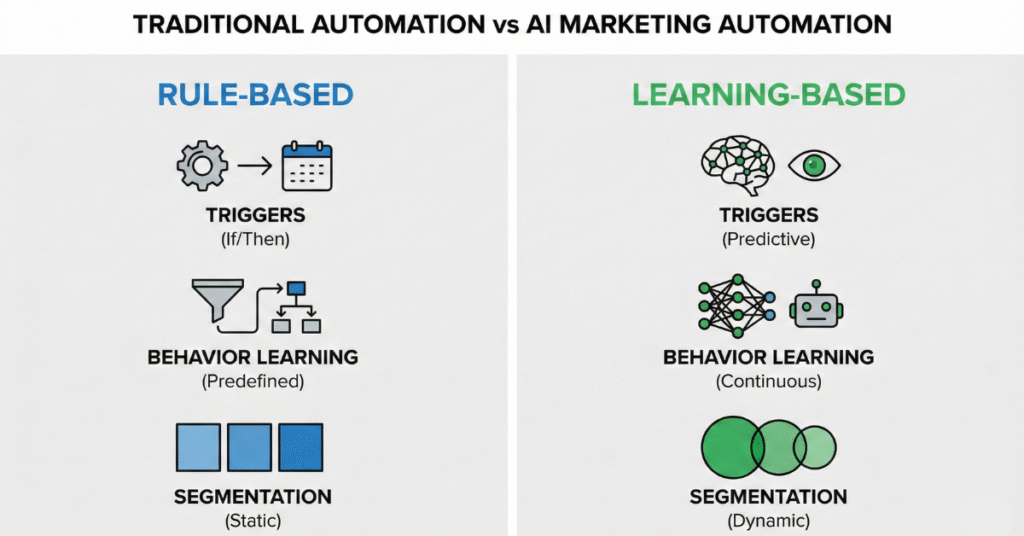
AI marketing automation refers to the use of artificial intelligence (machine learning, predictive analytics, natural language processing) combined with automated workflows to manage and optimize marketing efforts end to end.
It goes beyond traditional marketing automation (which relies on static rules and pre-defined triggers) by:
- Continuously learning from customer behavior and performance data.
- Making real-time, data-driven decisions (e.g., sending the right message at the right time).
- Personalizing content and journeys to individual preferences.
- Automatically optimizing campaigns, budgets, and segmentation.
- Providing strategic insights, forecasting, and performance recommendations.
A mature AI marketing automation system typically includes:
- A unified data infrastructure (CRM, CDP, analytics data layer)
- Data ingestion, cleaning, and integration across channels
- AI-powered analytics and insights (segmentation, predictive models, trend detection)
- Automated campaign workflows (email, ads, chatbots, content, cross-channel)
- Personalization engines and content optimization
- Lead scoring, segmentation, and orchestration of customer journey
- Monitoring, reporting, and performance feedback loops
- Governance, privacy compliance, and data quality controls
Who Benefits, And Who Should Wait
Best suited for:
- Small to mid-size companies looking to scale without proportionally increasing staff.
- B2C and B2B businesses with multi-step customer journeys.
- Teams managing multiple channels (email, social, ads, content, chat).
- Organizations aiming for data-driven marketing, not guesswork.
- Teams ready to implement process discipline and invest in data hygiene.
May not benefit immediately:
- Businesses with one-off sales and no real need for ongoing engagement.
- Companies lacking basic data infrastructure or uninterested in improving data quality.
- Teams with zero bandwidth or culture for process change and automation upkeep.
If foundational marketing strategy, data practices, or customer journey clarity are missing, automation will magnify inefficiencies rather than solve them.
Use Cases for B2C and B2B
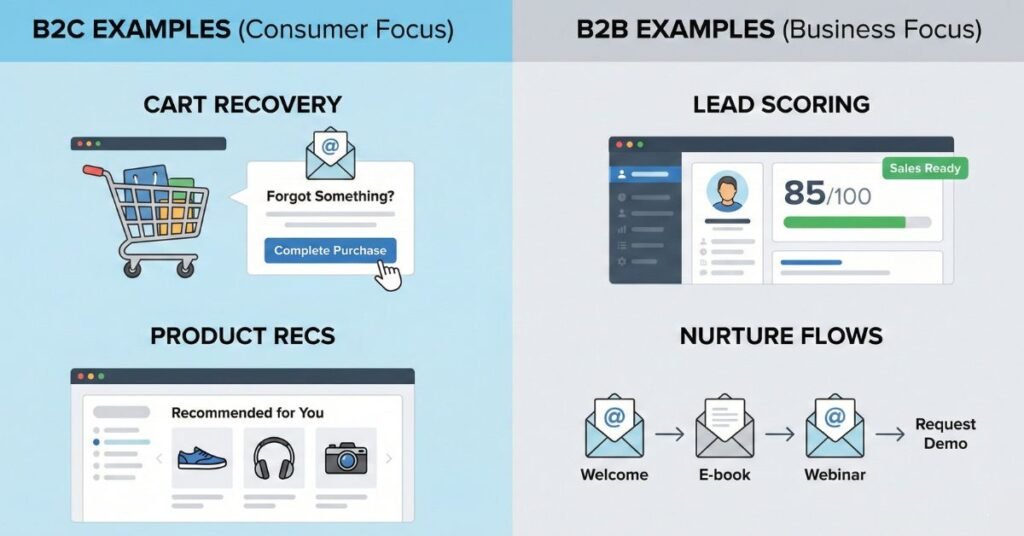
For B2C (e-commerce, SaaS, D2C brands)
- Personalized email and SMS campaigns based on user behavior (browsing history, cart abandonment)
- Dynamic product recommendations and retargeting ads
- Chatbots / conversational marketing for 24/7 support and conversions
- Automated re-engagement campaigns, win-back flows, churn prevention
- Content personalization (website, newsletters, push notifications)
For B2B or Service Businesses (longer cycles, higher touch)
- Lead scoring and prioritization, surface high-quality leads, route to sales
- Automated nurture sequences with content tailored to buyer persona and stage in funnel
- Insight-driven content recommendations (blogs, whitepapers, case studies)
- Trigger-based communication (after demo, trial expiration, content download)
- Forecasting and pipeline analytics, predict conversion likelihood, forecast revenue
In both cases a unified data model and AI intelligence improves targeting, timing, and personalization, not just broad automation.
Measuring Success: What to Track & How to Iterate
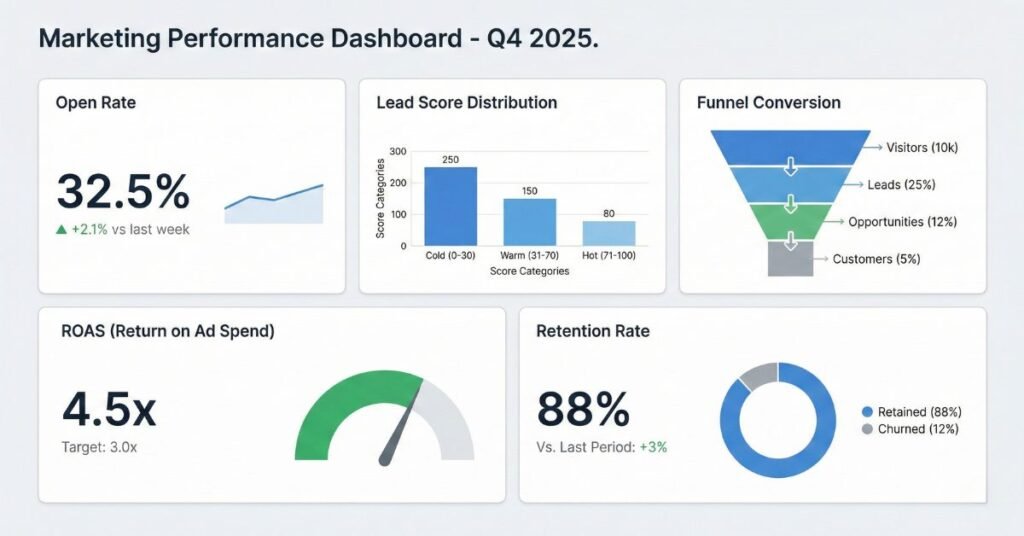
Key metrics vary by business type, but generally include:
- Engagement metrics: open rate, click-through rate, conversion rate (form fills, purchases, sign-ups)
- Lead quality: lead score distribution, conversion from lead to opportunity / sale
- Funnel efficiency: time-to-conversion, drop-off points, cost per acquisition (CPA), time-to-value
- Lifetime value (for recurring business), churn or retention rate
- Return on Ad Spend (ROAS), marketing ROI
- Workflow / operational efficiency: reduction in manual tasks, time saved, speed of follow-up, error rate
Set baseline metrics before automation, define target improvements, and monitor continuously. Use insights from AI analytics to iterate and improve workflows.
Common Mistakes, Challenges, and How to Avoid Them
- Automating broken processes: Don’t automate what doesn’t work. Fix strategy first.
- Ignoring data quality: AI is only as good as your data. Invest in cleanup, unification, governance.
- Tool sprawl: Using too many tools/all-in-one. Better to have a lean, well-integrated stack.
- Over-automation and loss of personalization authenticity: Don’t let automation make communications robotic. Maintain human oversight.
- Lack of compliance and privacy planning: Especially if operating globally. Ensure consent, data governance, transparency.
- Treating automation as “set and forget”: Automation needs periodic review, tuning, and iteration.
Scaling Over Time: From Small Business to Enterprise-Level AI Marketing
As your business grows:
- Start with simple workflows (emails, segmentation) and add AI intelligence gradually.
- Build a core team or champion. Someone responsible for data integrity, automation governance, and performance tracking.
- Keep infrastructure flexible. Choose tools/platforms that integrate and scale. Avoid proprietary silos.
- Document flows, logic, and decision criteria. Maintain transparency.
- Combine automation with human judgment. Use AI for suggestions, humans for decisions.
- Periodically audit performance, data quality, compliance. Avoid technical debt and “automation rot.”
When to Hire Expert Help
Consider external help when:
- Your internal team lacks technical expertise or bandwidth.
- You need cross-channel integration (CRM, ads, email, social, analytics) for the first time.
- You want to scale quickly without disrupting operations.
- Your campaigns or customer journeys are complex (multiple segments, long sales cycles).
- You need to ensure compliance, data governance, and ongoing maintenance.
An experienced consultant or agency helps with technical setup, data infrastructure, governance, and avoids common pitfalls, letting you focus on strategy instead of plumbing.
Ethical & Governance Considerations
AI-powered marketing depends heavily on data. As you build your system, pay attention to:
- Customer consent and data privacy (compliance with local and international regulations)
- Transparency (let users know when content or recommendations are AI-driven)
- Bias and fairness (avoid over-targeting or excluding certain audiences)
- Data security and access control
- Regular audits and clean-up of outdated or irrelevant data
Treat data not just as fuel for AI, but as a responsibility.
Who This Guide Is For, And Who Should Wait
This guide is aimed at businesses that are ready to scale with multiple touchpoints, customer journeys, or marketing channels, and are willing to invest effort in data readiness and process discipline.
If you are a freelancer, very small business, or have only occasional marketing needs, you may benefit from simpler automation (basic email scheduling, rule-based automation) rather than full-blown AI marketing automation.
On the other hand if you have longer-term growth ambition, recurring customer flows, or complex buyer journeys, this guide is suited to you.
Conclusion & Next Steps
AI marketing automation is not a silver bullet. It is a strategic system. One that integrates data, technology, people, and process into a unified engine for growth. When designed carefully, it helps businesses scale, deliver consistent customer experiences, and turn marketing from chaotic tasks into a reliable growth driver.
Start by mapping your customer journey and auditing your data. Then pick a workflow to automate. Build step by step, integrate tools, add AI intelligence, measure results, iterate.
If you would like help designing your automation roadmap or building a scalable AI-powered marketing system, we are available to consult and guide you through the process.