
Digital marketing today is powered by dozens of disconnected tools.
Marketers manage SEO with one platform, email campaigns with another, paid ads from multiple dashboards, and customer data inside a CRM. Each tool performs a specific function, but the overall system often depends on manual coordination. Campaigns are launched, optimized, paused, and adjusted by people constantly moving between platforms.
As marketing channels multiply, this approach becomes harder to scale. Teams spend more time managing tools and workflows than focusing on strategy and growth.
This is where a new shift is beginning to take shape.
Instead of relying only on AI marketing automation tools that wait for instructions, businesses are starting to use AI agents. These are systems that can analyze data, make decisions, and execute marketing tasks with minimal human input. Rather than assisting marketers with isolated tasks like writing copy or generating images, AI agents can handle multi-step workflows across the marketing process.
For example, an AI agent might:
- analyze search trends
- generate content ideas
- produce optimized blog posts
- publish them to a CMS
- monitor engagement
- refine the strategy based on performance data
This changes the role of technology in marketing. Tools become part of a larger system that can observe, decide, and act continuously.
But the real transformation goes beyond individual agents.
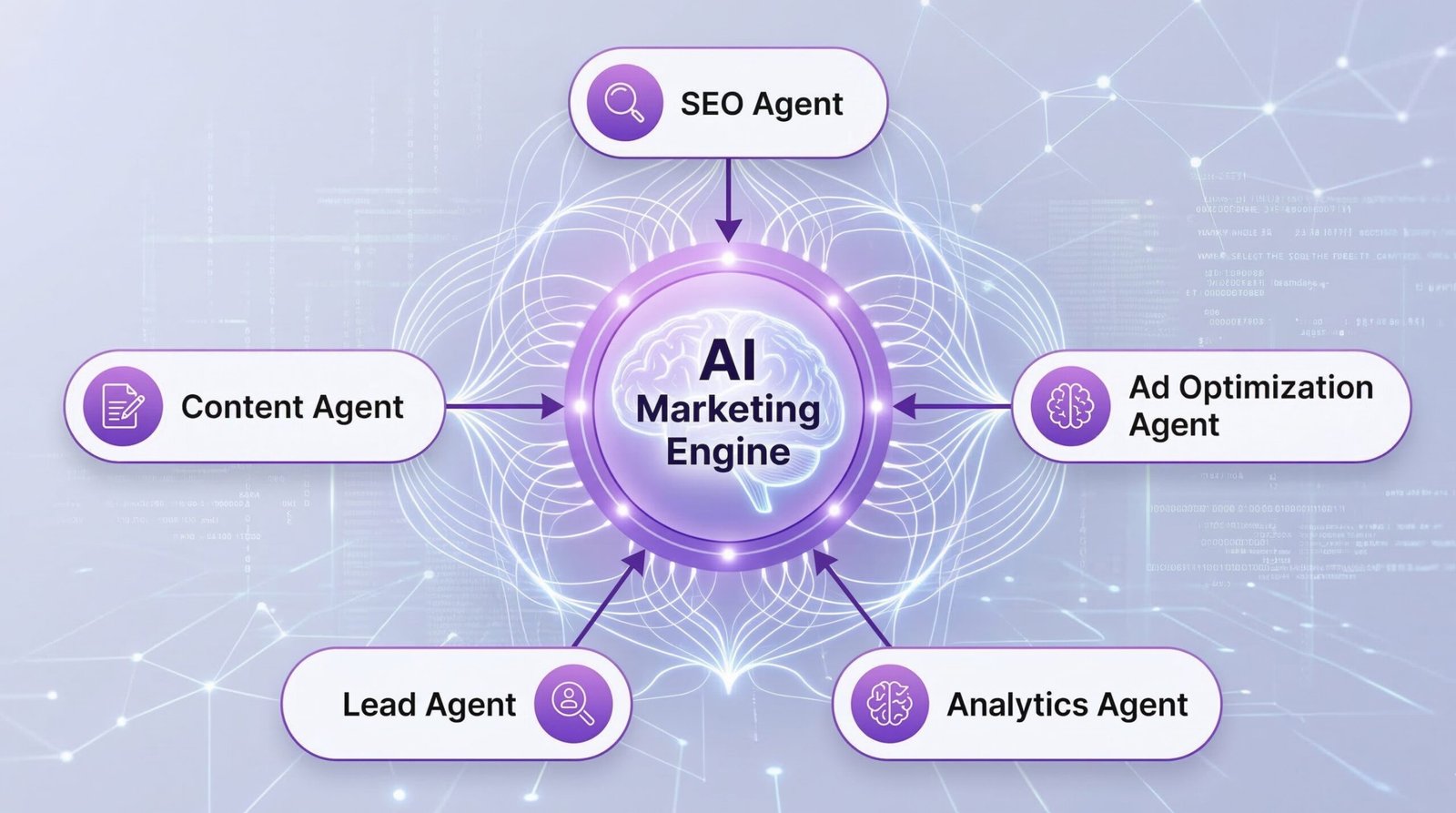
When multiple AI agents work together across traffic generation, lead nurturing, conversion optimization, and customer retention, they form something much more powerful: an AI-powered marketing engine.
Instead of running one campaign at a time, these systems operate continuously, learning from data and improving performance over time.
Understanding this shift is becoming essential for businesses that want marketing systems that are smarter, faster, and built to scale.

What Are AI Agents in Digital Marketing?
To understand how AI agents are transforming digital marketing, it helps to first understand what makes an AI agent different from the AI tools most marketers already use.
An AI agent is a system designed to pursue a goal by continuously interacting with its environment. Instead of simply generating responses to prompts, an AI agent can observe data, make decisions, perform tasks, and improve based on results.
In simple terms, an AI agent can:
Observe data
It collects information from multiple sources such as analytics platforms, CRM systems, ad accounts, or website activity.
Reason about goals
Using AI models and predefined objectives, the agent analyzes patterns and determines what actions will move the system closer to its goal.
Take actions
The agent can trigger tasks through integrations and APIs. This might include publishing content, sending emails, adjusting ad budgets, or updating CRM records.
Learn from outcomes
By analyzing performance data such as engagement rates, conversions, or traffic trends, the agent can refine future actions and improve results over time.
This ability to continuously observe, decide, act, and learn is what makes AI agents fundamentally different from traditional software tools.
The Evolution of AI in Marketing
To see why AI agents represent such a significant shift, it helps to look at the evolution of how AI has been used in marketing so far. Most organizations today are still operating in the first two stages.
AI Tools
The first stage of AI in marketing consists of tools that respond to prompts. These tools are powerful, but they are still passive systems. They wait for instructions and generate outputs based on user input.
For example, a marketer might ask an AI tool to generate a blog post, write product descriptions, or create ad copy. The tool performs the task, but the marketer still manages the entire workflow manually.
Example:
Generate blog content based on a prompt.
While this saves time, it does not change how the overall marketing system operates.
AI Assistants
The next stage introduces AI assistants, which help marketers perform tasks more efficiently. These assistants can suggest improvements, analyze data, and automate certain steps within existing workflows.
For example, an AI assistant inside an advertising platform might suggest new ad copy, recommend audiences to target, or highlight performance trends. These systems support decision-making, but humans still control the process.
Example:
Suggest variations of ad copy based on campaign performance.
AI assistants make marketing workflows faster and more data-driven, but they are still primarily support tools for human operators.
AI Agents
AI agents represent the next evolution.
Instead of waiting for prompts or assisting with isolated tasks, AI agents can execute multi-step marketing workflows autonomously. They work toward a defined objective and coordinate multiple actions across different platforms.
For example, an AI agent managing a content pipeline might:
- Research high-value keywords
- Analyze competing content
- Generate a blog article
- Optimize it for search engines
- Publish it to a content management system
- Promote it across social channels
- Track engagement and search performance
- Adjust the content strategy based on results
In this scenario, the AI agent is not just producing content. It is operating an entire workflow, connecting research, creation, distribution, and optimization into a continuous system.
This shift from tools to agents marks an important milestone in digital marketing. Instead of marketers manually coordinating dozens of tasks, AI agents can begin to manage entire marketing processes.
And when multiple agents work together across traffic generation, lead nurturing, and campaign optimization, they form the foundation of something even more powerful: AI-powered marketing engines.
Why Traditional Marketing Automation Is Breaking Down
For years, marketing automation has been considered the foundation of scalable digital marketing. Platforms like email automation tools, CRM workflows, and campaign builders allow businesses to automate repetitive tasks such as sending emails, tagging leads, or assigning follow-ups.
These systems helped marketers move away from completely manual operations. Instead of sending every email or managing every interaction individually, automation platforms allowed teams to create predefined workflows that trigger actions based on specific events.
A typical example might look like this:
If a visitor downloads an ebook → send a follow-up email.
If they open that email → send a second email.
If they click the link → notify the sales team.
This kind of automation works well for predictable processes. It ensures that every lead receives a response and that important tasks are not missed.
However, most traditional marketing automation is built on rule-based logic. Every workflow must be designed in advance, and every possible path must be manually defined. As customer behavior becomes more complex and marketing channels continue to expand, this rigid structure begins to show its limitations.
Modern customer journeys rarely follow a straight line. A potential customer might read a blog post, watch a video on social media, visit a product page, leave the site, return days later through a search result, and only then consider downloading a resource or signing up for a demo.
In this kind of environment, simple “if-this-then-that” rules struggle to keep up.
The Limitations of Traditional Marketing Automation
While automation platforms are still valuable, they often struggle to adapt to dynamic customer behavior. Several limitations have become increasingly clear.
Rigid workflows
Automation systems rely on predefined sequences. Once a workflow is built, it follows the same logic every time. If a customer behaves differently than expected, the system cannot easily adjust.
For example, a lead who is highly interested might still receive the same generic email sequence as someone who only downloaded a resource casually.
Static decision rules
Automation decisions are typically based on simple conditions such as clicks, form submissions, or page visits. These signals do not always reflect true customer intent, and they rarely capture the full context of a user’s behavior.
As a result, automation systems often treat very different prospects in the same way.
Lack of contextual understanding
Traditional automation systems cannot truly understand the meaning behind user behavior. They can detect that someone visited a page, but they cannot analyze patterns across multiple channels to interpret intent or urgency.
This lack of context makes personalization difficult.
Limited optimization
Automation workflows are usually designed once and then adjusted manually over time. Marketers must constantly review performance, identify weaknesses, and redesign workflows themselves. The system does not improve automatically based on new data.
The Rise of Intelligent Marketing Systems
AI agents address many of these limitations by introducing adaptive decision-making into marketing systems.
Instead of relying entirely on predefined rules, AI agents can analyze patterns across large datasets and determine the most appropriate action in real time.
This allows marketing systems to become more flexible and responsive.
AI agents can enable capabilities such as:
Adaptive decision-making
Instead of sending the same message to every lead, AI agents can analyze behavioral signals, engagement patterns, and historical data to determine the most relevant next step.
Real-time optimization
AI agents can continuously monitor performance data such as conversions, engagement rates, or campaign results. Based on these insights, they can adjust strategies automatically without requiring manual intervention.
Contextual responses
By analyzing multiple signals across platforms such as website activity, CRM records, email engagement, and advertising interactions, AI agents can respond to customer behavior in a much more personalized and context-aware way.
From Automation to Intelligence
The shift from traditional automation to AI-driven systems represents an important evolution in digital marketing.
Automation helps marketers execute workflows more efficiently.
AI agents allow marketing systems to think, adapt, and improve over time.
Instead of static workflows that require constant manual updates, intelligent marketing systems can continuously analyze data, experiment with new approaches, and optimize performance.
This shift is what ultimately enables the development of AI-powered marketing engines, where multiple agents work together to manage marketing activities across the entire customer journey.
How AI Agents Actually Work
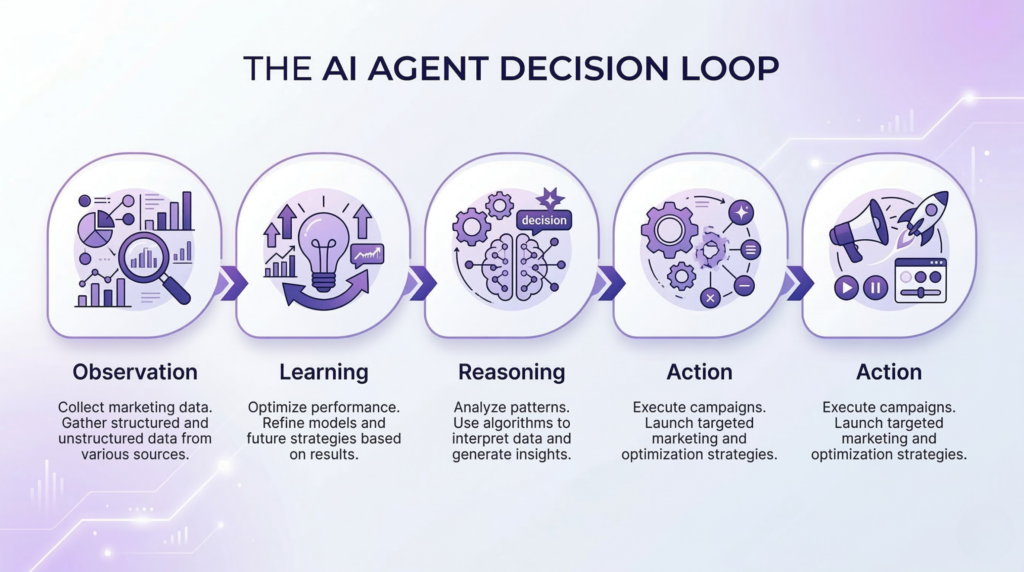
To understand why AI agents are so powerful in digital marketing, it helps to look at how they operate internally. Unlike traditional automation systems that follow fixed rules, AI agents operate through a continuous decision loop that allows them to observe, analyze, act, and improve.
This loop enables AI agents to manage complex workflows and adapt their behavior as new information becomes available.
At a high level, most AI agents operate through four core stages: observation, reasoning, action, and learning.
Observation
The first step in the agent’s decision cycle is collecting data from the environment in which it operates. In digital marketing, this environment includes multiple systems that generate valuable signals about user behavior and campaign performance.
An AI agent might gather data from:
- website analytics platforms
- CRM systems
- email marketing tools
- advertising platforms
- social media engagement metrics
- content performance data
For example, an AI agent monitoring a website might observe that a particular blog post is generating increased traffic from search engines. At the same time, it might detect that visitors from that article are spending a long time on the page but not converting.
These signals become the raw information the agent uses to decide what to do next.
Reasoning
Once data has been collected, the AI agent analyzes it to determine the most appropriate action. This stage involves identifying patterns, interpreting signals, and comparing outcomes against predefined goals.
In digital marketing, those goals might include:
- increasing organic traffic
- improving lead conversion rates
- maximizing advertising return on investment
- increasing engagement with content
Using AI models and decision logic, the agent evaluates the available data and determines the best next step to move closer to the desired outcome.
For example, if an agent analyzing marketing data discovers that certain keywords are generating high-quality traffic but have low content coverage on the website, it may decide that creating additional content around those keywords could increase search visibility and lead generation.
This reasoning process allows AI agents to make data-driven decisions without requiring manual analysis from a marketing team.
Action
After determining the most appropriate response, the AI agent executes the task. This is where integrations with other platforms become essential.
AI agents typically interact with marketing tools through APIs and automation systems. This allows them to perform tasks across different platforms, including:
- publishing content to a CMS
- sending personalized emails
- updating CRM records
- adjusting advertising budgets
- scheduling social media posts
- generating reports
The ability to take direct action across multiple systems transforms AI agents from passive analysis tools into active operators within the marketing ecosystem.
For example, if an AI agent determines that a particular audience segment is responding well to a campaign, it might automatically increase the advertising budget for that audience while pausing underperforming segments.
Learning
The final stage of the decision loop is learning from outcomes. Once the AI agent takes action, it continues monitoring the results of that action to evaluate whether the decision improved performance.
Key performance signals might include:
- conversion rates
- click-through rates
- cost per acquisition
- engagement metrics
- revenue generated from campaigns
By analyzing these outcomes, the agent refines its understanding of what works and what does not. Over time, this feedback loop allows the system to continuously improve.
For example, if a particular ad creative consistently generates higher engagement, the AI agent can prioritize similar messaging or visual styles in future campaigns.
Example: An AI Ad Optimization Agent
To see how this decision loop works in practice, consider an AI agent designed to optimize advertising campaigns.
The agent begins by collecting performance data from advertising platforms such as impressions, clicks, conversions, and audience behavior. This represents the observation phase.
Next, the system analyzes which ads are generating the highest conversion rates and which audiences are responding most effectively. Based on this analysis, the agent decides which campaigns should receive additional budget and which ads should be paused.
Once the decision is made, the agent performs actions such as adjusting campaign budgets, launching new ad variations, or testing alternative creatives.
Finally, the system monitors how those changes affect campaign performance. If the adjustments improve conversion rates or reduce acquisition costs, the agent incorporates those insights into future decisions.
Through this continuous cycle of observing data, reasoning about outcomes, taking action, and learning from results, AI agents can manage marketing operations in a way that becomes smarter over time.
This ability to operate in a continuous feedback loop is what allows AI agents to power more advanced systems, where multiple agents collaborate to run different parts of the marketing process simultaneously.
AI Agents Across the Entire Marketing Funnel
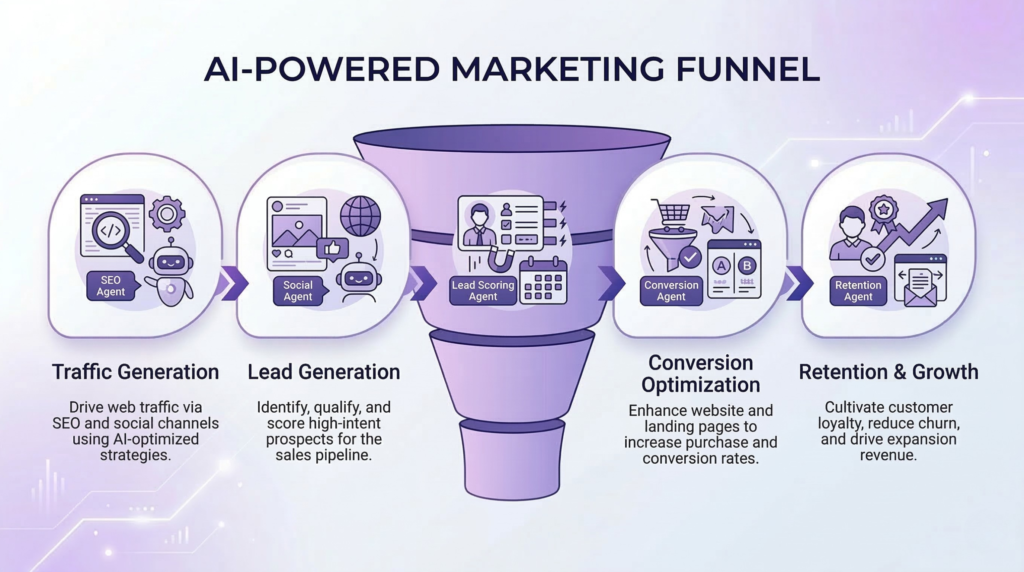
One of the biggest misconceptions about AI in marketing is that it is primarily used for content generation or analytics. In reality, AI agents can operate across the entire marketing funnel, supporting everything from traffic generation to customer retention.
Most marketing systems are traditionally divided into stages. Each stage requires different tools, workflows, and strategies. AI agents can operate within each of these stages and coordinate actions between them, creating a more connected and responsive marketing system.
Understanding how AI agents function across the full funnel helps illustrate how they move marketing from isolated tasks toward intelligent, integrated systems.
Top of Funnel: Traffic Generation
At the top of the funnel, the goal is to attract potential customers and introduce them to the brand. This stage often relies heavily on AI-powered SEO and content marketing strategies, search visibility, and social media engagement.
AI agents can help manage many of the processes involved in generating and distributing content.
AI SEO Agents
Search engine optimization involves a large number of repetitive and data-driven tasks. AI agents can monitor search trends, analyze competitor strategies, and continuously identify opportunities for new content.
Typical tasks for an AI SEO agent may include:
- conducting keyword research based on search trends
- analyzing competing content in search results
- identifying gaps in existing content coverage
- generating article outlines or content briefs
- creating optimized blog posts
- suggesting internal links between related pages
Because AI agents can monitor performance data continuously, they can also identify which content topics generate the most traffic and adjust the content strategy accordingly.
AI Social Media Agents
Social media marketing also benefits from automation, especially when it comes to content scheduling and performance analysis. AI agents can generate posts, monitor engagement patterns, and determine which types of content resonate with audiences.
Typical tasks for an AI social media agent include:
- generating post ideas and captions
- scheduling content across social platforms
- analyzing engagement metrics such as likes, shares, and comments
- identifying trending topics relevant to the audience
- recommending the best times to publish content
By analyzing audience engagement data, these agents can continuously refine social media strategies and increase reach over time.
Middle of Funnel: Lead Generation
Once visitors begin interacting with a brand, the next step is capturing leads and understanding their level of interest. This stage involves identifying potential customers and guiding them toward deeper engagement.
AI agents can help analyze visitor behavior and determine which prospects are most likely to convert.
AI Lead Qualification Agents
Lead qualification is often a complex process that requires analyzing multiple signals such as page visits, content downloads, email engagement, and previous interactions with the brand.
AI agents can monitor these signals in real time and evaluate the likelihood that a lead is ready for further engagement.
Typical tasks for a lead qualification agent include:
- analyzing visitor behavior on the website
- assigning lead scores based on engagement patterns
- segmenting prospects into audience groups
- personalizing messaging based on interests or activity
For example, a visitor might download a guide from a website. Instead of sending the same generic follow-up email to every lead, an AI agent could analyze the visitor’s browsing behavior, determine their level of interest, and assign a lead score.
A possible workflow could look like this:
A visitor downloads a guide from a landing page.
The AI agent analyzes their activity on the site and identifies the topics they explored.
Based on this behavior, the system assigns a lead score that reflects their level of interest.
The AI agent then sends a personalized follow-up email with resources tailored to that specific topic.
This kind of contextual response improves the chances of converting a visitor into a qualified lead.
Bottom of Funnel: Conversion Optimization
At the bottom of the funnel, marketing efforts focus on converting qualified prospects into customers. This stage often involves personalized offers, targeted messaging, and coordination between marketing and sales teams.
AI agents can assist in identifying buying signals and delivering the right message at the right time.
AI Conversion Agents
Conversion-focused AI agents analyze signals that indicate purchase intent. These signals may include repeated visits to product pages, high engagement with pricing information, or strong interaction with sales content.
Typical tasks for conversion agents include:
- analyzing signals that indicate buying intent
- personalizing landing pages or offers
- triggering follow-up communications
- optimizing pricing or promotional strategies
For example, if a visitor repeatedly returns to a product page or spends time reviewing pricing details, an AI agent might trigger a targeted email with additional product information or offer a consultation call with a sales representative.
By responding to real-time signals, AI agents help ensure that potential customers receive the most relevant information at critical decision points.
Post-Purchase: Retention and Growth
The marketing journey does not end when a customer makes a purchase. Retaining customers and encouraging repeat engagement is often more valuable than acquiring new ones.
AI agents can monitor customer behavior after purchase and identify opportunities to strengthen long-term relationships.
AI Retention Agents
Retention-focused agents analyze customer activity and identify when engagement begins to decline or when opportunities for upselling or cross-selling appear.
Typical tasks for retention agents include:
- analyzing customer usage or activity patterns
- identifying signs of declining engagement
- triggering re-engagement campaigns
- recommending loyalty offers or personalized promotions
For example, if a customer has not interacted with a product or service for a certain period, an AI agent might automatically send a re-engagement message with helpful resources, product updates, or special offers.
By continuously monitoring customer behavior, AI agents help businesses maintain stronger relationships with their audience and increase lifetime customer value.
A Connected Funnel Powered by AI
When AI agents operate across each stage of the marketing funnel, they create a more responsive and integrated system. Instead of isolated campaigns or disconnected tools, marketing activities become part of a coordinated process that continuously adapts to user behavior.
This coordinated approach lays the groundwork for something even more powerful: AI-powered marketing engines, where multiple agents collaborate to manage traffic generation, lead nurturing, conversion optimization, and customer retention as a unified system.
Real AI Marketing Workflows
Many articles discussing AI in marketing remain theoretical. They explain what AI agents are and list possible use cases, but they rarely demonstrate how these systems actually operate in real marketing environments.
To understand the true impact of AI agents, it helps to visualize them as part of complete workflows. Instead of assisting with a single task, AI agents can coordinate multiple steps across different tools and platforms to manage an entire process.
Below are examples of how AI agents can operate within real marketing systems.
AI SEO Content Engine
Content marketing and AI-driven SEO workflows involve a long chain of tasks. Traditionally, marketers must perform keyword research, analyze competitors, create content briefs, write articles, optimize them for search engines, publish them, and then monitor their performance.
An AI-powered SEO content engine can manage many of these steps automatically.
A typical workflow might look like this:
First, the AI agent performs keyword research by analyzing search trends and identifying opportunities where the website can gain visibility. It may evaluate search volume, competition levels, and the intent behind specific queries.
Next, the agent performs competitor analysis. It studies the pages currently ranking for target keywords, identifying gaps in content coverage or areas where deeper insights could outperform existing articles.
Based on this analysis, the AI agent generates an article outline. This outline may include suggested headings, relevant questions to answer, and key topics that should be covered to match search intent.
Once the structure is defined, the agent proceeds to content generation, producing a full article draft aligned with the selected keywords and topic structure.
The next step involves SEO optimization. The system may adjust headings, recommend internal links to related pages, optimize meta descriptions, and ensure that the content aligns with search engine best practices.
After optimization, the agent can publish the article to a content management system, making it live on the website without requiring manual intervention.
Once the article is published, the agent begins distribution, promoting the content through social media posts, newsletters, or other marketing channels.
Finally, the AI agent performs performance tracking. It monitors metrics such as search rankings, organic traffic, engagement levels, and conversions. If certain topics or keywords perform better than expected, the system can incorporate those insights into future content strategies.
This type of workflow transforms content marketing from a manual production process into a continuous, data-driven content engine.
AI Lead Nurturing System
Another powerful application of AI agents is managing the lead nurturing process. In many businesses, leads enter the funnel through content downloads, newsletter signups, demo requests, or webinar registrations.
Traditional marketing automation often sends the same sequence of emails to every lead. However, AI agents can make this process far more dynamic and personalized.
A typical AI-powered lead nurturing workflow might operate as follows.
When a visitor enters the funnel, perhaps by downloading a guide or signing up for a resource, the AI agent begins by analyzing behavioral signals. These signals might include which pages the visitor viewed, how long they stayed on the site, and what topics they engaged with most.
Based on this data, the agent segments the audience automatically. Some visitors may appear to be early-stage researchers, while others may already be exploring pricing or product details.
Once segmentation is complete, the system sends a personalized follow-up email tailored to the visitor’s interests. Instead of generic messaging, the content can reference specific topics the visitor engaged with on the website.
As the lead continues interacting with emails or website content, the agent tracks engagement signals such as email opens, link clicks, and additional page visits.
If a lead shows strong buying signals, the AI agent can alert the sales team or trigger additional actions such as scheduling a consultation invitation or offering a product demo.
This type of workflow allows businesses to nurture leads in a way that feels more relevant and responsive, increasing the likelihood of conversion.
AI Ad Optimization System
Managing digital advertising campaigns can be complex, particularly when multiple audiences, creatives, and budgets are involved. AI agents can assist by continuously monitoring campaign performance and making adjustments based on real-time data.
An AI ad optimization system typically begins by collecting performance metrics from advertising platforms such as impressions, clicks, conversions, and cost-per-acquisition.
Once this data is gathered, the AI agent evaluates which campaigns and creative variations are delivering the best results.
If certain ads consistently underperform, the agent can pause those ads automatically to prevent wasted budget.
At the same time, the system may generate new ad variations, experimenting with different headlines, images, or messaging based on patterns observed in high-performing campaigns.
The AI agent can also adjust budgets dynamically, allocating more resources to audiences or campaigns that produce higher conversion rates.
In addition, the system can test new audience segments, exploring demographic or behavioral patterns that may reveal new opportunities for growth.
Over time, this continuous cycle of monitoring, testing, and optimization allows advertising campaigns to improve without requiring constant manual adjustments from marketing teams.
From Individual Workflows to Marketing Systems
Each of these workflows demonstrates how AI agents can manage specific parts of the marketing process. When these systems are combined across content creation, lead nurturing, and campaign optimization, they begin to form a more cohesive marketing infrastructure.
Instead of isolated tasks performed manually by different teams, AI agents coordinate actions across multiple channels and tools.
This shift allows marketing to evolve from a collection of separate activities into a connected system that continuously analyzes data, executes strategies, and improves performance over time.
The AI Marketing Agent Technology Stack
Understanding AI agents conceptually is helpful, but to actually deploy them in real marketing environments, businesses need the right technology architecture. AI agents do not operate in isolation. They rely on a stack of interconnected systems that allow them to analyze information, make decisions, and execute actions across marketing platforms.
Most AI-driven marketing systems are built on several core layers that work together to enable intelligent automation. These layers include the reasoning layer, automation and orchestration systems, data infrastructure, execution platforms, and continuous feedback mechanisms.
When these components are properly integrated, they create the foundation for scalable AI-powered marketing systems.
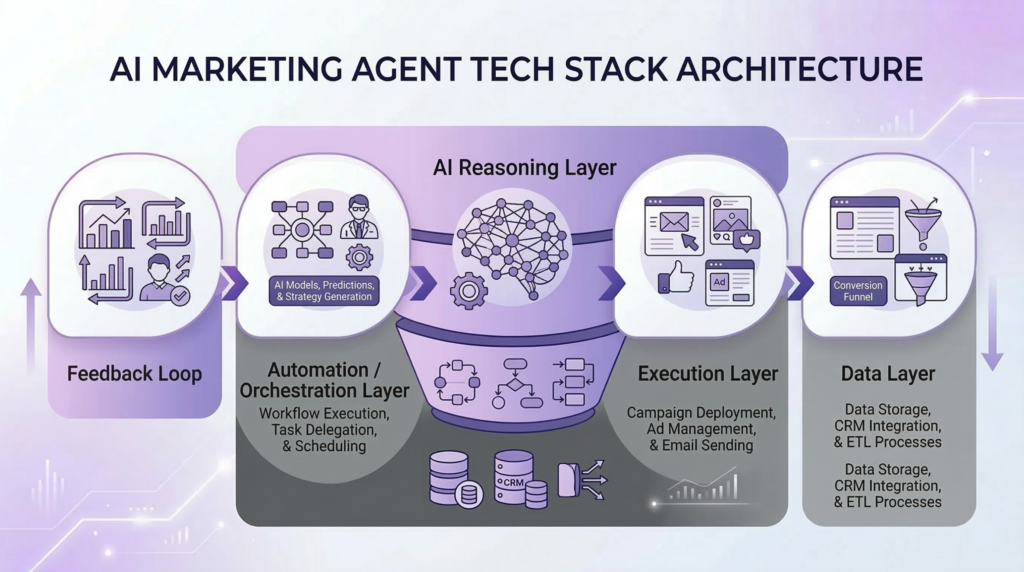
AI Reasoning Layer
At the center of an AI agent system is the reasoning layer. This is where AI models analyze information, interpret context, and determine what actions should be taken.
Large language models and other AI models are commonly used for this purpose. These models can process natural language, analyze patterns in data, and generate insights that guide decision-making.
Examples of AI models often used in marketing systems include:
- OpenAI models, which can generate content, analyze text data, and support reasoning tasks.
- Claude, which is often used for long-form content generation and contextual analysis.
- Gemini, which integrates well with various data and productivity ecosystems.
These models provide the intelligence layer of the system. They help AI agents understand marketing data, interpret user behavior, and determine appropriate next steps within a workflow.
However, the reasoning layer alone cannot operate marketing systems. It must be connected to tools that allow it to trigger actions and access real-world data.
Automation and Orchestration Layer
Once an AI model determines what action should be taken, the system needs a way to execute that decision across different platforms. This is where automation and orchestration tools play a critical role.
Automation platforms allow AI agents to connect multiple applications and coordinate workflows across modern business automation systems. They act as the control layer that moves information between tools and triggers actions when certain conditions are met.
Common automation platforms include:
- n8n, which allows users to build complex workflow automation and integrate AI models into decision-making processes.
- Make, which connects various marketing tools through visual automation workflows.
- Zapier, which enables integrations between thousands of web applications.
Through these platforms, AI agents can connect to marketing systems, retrieve data, and trigger actions such as sending emails, publishing content, or updating customer records.
Automation and orchestration layers essentially function as the operational backbone that allows AI agents to interact with the rest of the marketing ecosystem.
Data Layer
AI agents rely heavily on data to make informed decisions. Without accurate and accessible data sources, even the most advanced AI systems cannot perform effectively.
The data layer consists of platforms that store and organize information about customers, campaigns, and marketing performance.
Examples of data systems include:
- Customer relationship management platforms that track leads, customers, and sales interactions.
- Analytics platforms that measure website traffic, user behavior, and engagement metrics.
- Customer data platforms that unify information from multiple sources to create a comprehensive view of each user.
By connecting AI agents to these data systems, businesses enable the agents to analyze behavioral patterns, identify opportunities for optimization, and make decisions based on real-world signals.
The quality of the data layer often determines how effective AI-driven marketing systems will be.
Execution Layer
After an AI agent analyzes data and determines the appropriate action, it must be able to perform tasks within the tools that marketers already use. This is where the execution layer comes into play.
Execution platforms are the systems where marketing activities actually occur. AI agents interact with these platforms through APIs or automation workflows to carry out tasks.
Examples of execution platforms include:
- Email marketing platforms that deliver newsletters, nurture sequences, and transactional messages.
- Advertising platforms that manage paid campaigns and audience targeting.
- Content management systems where articles, landing pages, and resources are published.
- Social media platforms used to distribute content and engage with audiences.
By connecting AI agents to these systems, marketing teams can allow AI-driven workflows to perform actions automatically while maintaining control over brand messaging and campaign strategy.
Feedback and Learning Loop
One of the defining characteristics of AI agents is their ability to improve over time. This is made possible through the feedback loop.
After an agent performs an action such as launching a campaign, sending an email, or publishing content, the system monitors the results. Performance metrics such as conversion rates, engagement levels, and customer behavior are collected and analyzed.
This feedback data helps the AI agent evaluate whether its actions were successful.
For example, an AI agent managing advertising campaigns may analyze metrics such as cost-per-click, cost-per-acquisition, and return on ad spend. If a particular campaign consistently produces stronger results, the system can allocate more budget toward similar strategies.
Over time, this continuous learning process allows AI agents to refine their decision-making and optimize marketing performance.
Building Intelligent Marketing Infrastructure
When all these layers work together, they create a robust foundation for intelligent marketing systems. The reasoning layer provides decision-making capabilities, automation tools orchestrate workflows, data systems provide insights, execution platforms carry out actions, and feedback loops enable continuous improvement.
This architecture allows AI agents to operate across multiple marketing channels and coordinate complex workflows.
Rather than relying on isolated tools or manual processes, businesses can build connected marketing infrastructures where AI agents analyze data, trigger actions, and optimize strategies across the entire customer journey.
Multi-Agent Marketing Systems
Many discussions about AI agents focus on a single intelligent system performing a task. While this can be useful for specific workflows, the real transformation in digital marketing happens when multiple specialized AI agents work together as a coordinated system.
Marketing is inherently complex. It involves traffic generation, audience analysis, content production, lead nurturing, advertising optimization, and performance measurement. Expecting a single AI agent to manage all of these responsibilities effectively is unrealistic.
Instead, modern AI-driven marketing systems are increasingly designed around multi-agent architectures, where different agents specialize in specific tasks but share information with one another. Each agent focuses on a particular function, and together they operate as a connected ecosystem.
This approach mirrors how marketing teams traditionally work. In a typical organization, different specialists handle SEO, content creation, analytics, paid advertising, and lead management. A multi-agent system replicates this structure digitally, allowing intelligent agents to collaborate across the marketing process.
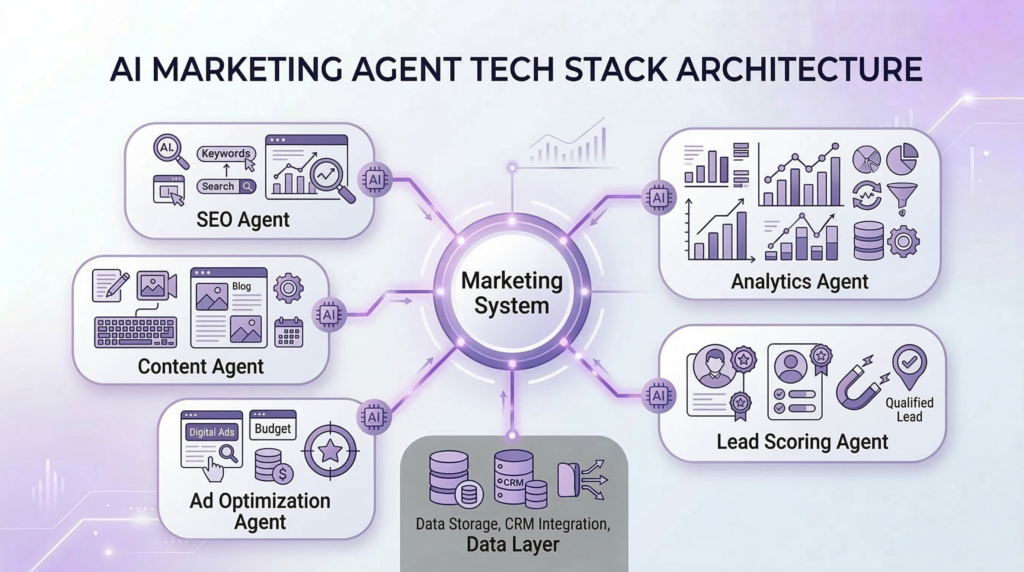
Specialized Marketing Agents
Within a multi-agent marketing system, different agents can be responsible for specific functions.
An SEO agent focuses on identifying opportunities for organic growth. It analyzes search trends, monitors rankings, and suggests new content topics based on keyword data and competitor performance. By continuously scanning search patterns, the SEO agent helps ensure that the website remains aligned with what audiences are actively searching for.
A content creation agent builds on the insights generated by the SEO agent. Using recommended topics and keywords, it can generate content outlines, produce drafts of articles, suggest headlines, and prepare content for publishing. It may also recommend internal links and optimize the structure of content to improve readability and search visibility.
An analytics agent monitors performance data across marketing channels. It collects information from analytics platforms, advertising dashboards, and CRM systems to identify patterns in user behavior and campaign effectiveness. The insights produced by this agent help other agents adjust their strategies.
A lead scoring agent evaluates incoming leads based on behavioral signals and engagement patterns. It analyzes how visitors interact with content, emails, and product pages to determine the likelihood that a prospect will convert into a customer. Based on these signals, it can assign scores, segment audiences, and trigger appropriate follow-up actions.
An ad optimization agent focuses on improving the performance of paid advertising campaigns. It continuously monitors metrics such as click-through rates, conversions, and acquisition costs. When it identifies underperforming ads, it can pause them automatically, test new variations, or adjust budgets to allocate more resources toward successful campaigns.
How Agents Collaborate
The real value of multi-agent systems emerges when these specialized agents begin sharing insights and coordinating actions.
For example, if the SEO agent identifies a rising search trend, the content creation agent can immediately generate new articles to target that topic. Once the content is published, the analytics agent monitors engagement and traffic data. If the content begins generating leads, the lead scoring agent evaluates those leads and determines which prospects require follow-up.
At the same time, the ad optimization agent might promote the highest-performing content through paid campaigns to amplify its reach.
Instead of operating as isolated tools, these agents form a network where information flows continuously between systems. Insights generated by one agent become input for another, creating a feedback-driven marketing environment.
From Isolated Tasks to Coordinated Systems
This multi-agent approach represents a significant shift from traditional marketing technology stacks. Historically, marketing tools operated independently, requiring human teams to interpret data and coordinate actions manually.
With multi-agent systems, many of these processes can be automated and synchronized. Agents can detect patterns, communicate with other agents, and adjust strategies dynamically.
For example:
The SEO agent identifies a high-potential keyword opportunity.
The content agent produces an optimized article targeting that keyword.
The analytics agent monitors traffic and engagement after publication.
The lead scoring agent evaluates visitors interacting with the content.
The ad optimization agent amplifies successful content through paid promotion.
Each agent performs a specialized function, but together they create a coordinated marketing workflow that continuously adapts and improves.
The Foundation of AI-Powered Marketing Engines
The concept of multi-agent collaboration is still relatively new in marketing discussions, and many existing articles focus only on individual AI tools or isolated automation workflows.
However, as marketing systems grow more complex, the ability for multiple agents to coordinate actions across platforms will become increasingly important.
When these agents work together across content creation, traffic generation, lead management, and campaign optimization, they begin to form the foundation of AI-powered marketing engines. These engines operate continuously, using data and intelligent decision-making to refine marketing strategies and drive growth over time.
From AI Agents to AI Marketing Engines
Up to this point, we have explored how individual AI agents can perform specific marketing tasks such as generating content, qualifying leads, optimizing ads, or analyzing campaign performance. While each of these capabilities is valuable on its own, the real transformation occurs when these agents are connected into a coordinated system.
This is where the concept of an AI marketing engine emerges.
An AI marketing engine is not a single tool or a single agent. It is a system in which multiple specialized AI agents work together to manage and optimize marketing activities across the entire customer journey. Instead of executing isolated tasks or individual campaigns, the system operates continuously, monitoring performance data and adapting strategies in real time.
In traditional marketing, campaigns are typically planned, launched, and optimized manually. Teams set up campaigns, monitor results, and adjust strategies periodically. While automation tools help streamline some of these tasks, the overall process still requires constant human intervention.
AI marketing engines introduce a different model. Rather than relying on static campaigns and manual adjustments, the system becomes self-operating and continuously improving.
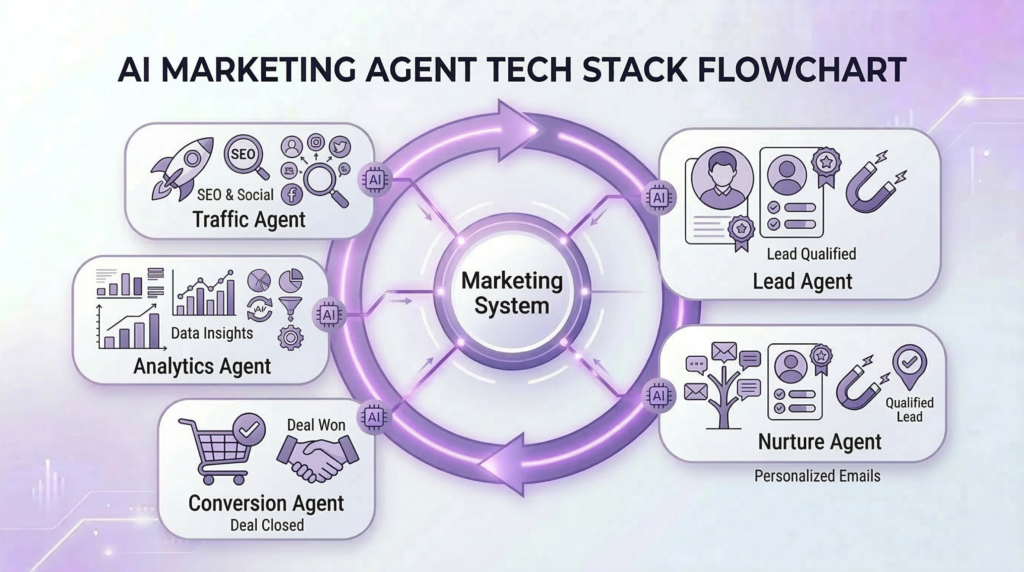
How an AI Marketing Engine Operates
An AI marketing engine functions as a network of specialized agents, each responsible for a particular part of the marketing process. These agents communicate with one another, share insights, and coordinate actions to achieve broader marketing goals.
For example, a marketing engine may include several core agents working together.
A traffic agent focuses on generating visibility and attracting new audiences. It monitors search trends, identifies new keyword opportunities, and supports the creation of content designed to capture organic traffic. This agent may also coordinate content distribution through social media channels or other publishing platforms.
A lead agent handles lead capture and qualification. When visitors interact with the website or download resources, the agent analyzes their behavior, assigns lead scores, and determines the level of interest shown by each prospect. This information helps prioritize the most promising leads.
A nurturing agent manages ongoing communication with leads who are not yet ready to convert. Based on engagement signals and behavioral data, the agent can deliver personalized email sequences, educational resources, and relevant offers designed to move prospects further along the customer journey.
A conversion agent focuses on turning qualified leads into customers. By analyzing buying signals such as repeated visits to product pages or interaction with pricing information, the agent can trigger targeted offers, optimize landing pages, or initiate sales follow-ups.
An analytics agent monitors the performance of the entire marketing system. It collects data from analytics platforms, advertising channels, and CRM systems to evaluate campaign effectiveness. Based on these insights, the agent provides feedback that helps other agents refine their strategies.
A Continuous Marketing System
When these agents operate together, marketing begins to function less like a series of separate campaigns and more like a continuous system.
For example, the traffic agent may identify new content opportunities based on search trends. The content created from these insights attracts new visitors to the website. As visitors interact with the content, the lead agent evaluates their behavior and assigns scores based on their engagement level.
Qualified leads are then nurtured through personalized communication sequences managed by the nurturing agent. When signals indicate that a prospect is ready to convert, the conversion agent initiates targeted actions designed to close the sale.
Meanwhile, the analytics agent continuously monitors performance data and feeds insights back into the system. If certain content topics drive higher conversions or specific campaigns outperform others, those insights are used to refine future strategies.
This cycle repeats continuously, allowing the system to evolve and improve over time.
From Campaigns to Engines
The key difference between traditional marketing and AI marketing engines lies in how strategies are executed.
Traditional marketing focuses on launching campaigns, analyzing results, and manually adjusting tactics. AI marketing engines operate as ongoing systems that analyze, execute, and optimize marketing activities automatically.
Instead of running individual campaigns that eventually end, businesses can operate a marketing engine that consistently generates traffic, nurtures leads, and improves conversion performance.
The Future of Scalable Marketing
As marketing environments grow more complex, the ability to coordinate data, content, advertising, and customer engagement becomes increasingly important. AI marketing engines provide a framework for managing this complexity.
By combining specialized AI agents into a unified system, businesses can build marketing infrastructures that adapt to customer behavior, respond to new opportunities, and continuously improve performance.
In this model, marketing is no longer a collection of disconnected activities. It becomes a self-optimizing system designed to support long-term growth.
Challenges and Risks of AI Marketing Agents
While AI agents can significantly improve marketing efficiency and scalability, they are not without limitations. Like any emerging technology, AI-driven systems introduce new challenges that businesses must carefully consider before deploying them at scale.
Understanding these risks is important for building responsible and effective marketing systems. When implemented thoughtfully, AI agents can deliver tremendous value. However, they work best when supported by strong data practices, governance frameworks, and human oversight.
Data Quality and Data Dependency
AI agents rely heavily on data to make decisions. If the underlying data is incomplete, outdated, or inaccurate, the decisions made by AI systems can lead to poor outcomes.
For example, a lead qualification agent might assign incorrect scores if the CRM contains outdated information about customer behavior. Similarly, an advertising optimization agent may allocate budget inefficiently if performance data is inconsistent or improperly tracked.
This makes data quality one of the most critical factors in successful AI-driven marketing systems. Businesses must ensure that their data infrastructure is well maintained, properly integrated, and capable of providing reliable signals for AI agents to analyze.
Organizations that invest in strong data governance are far more likely to benefit from AI-driven automation.
AI Hallucinations and Incorrect Outputs
Large language models and other AI systems sometimes produce incorrect or misleading outputs, a phenomenon often referred to as AI hallucination. In the context of marketing, this can result in inaccurate content, flawed insights, or misguided recommendations.
For instance, an AI content agent may generate information that appears credible but is factually incorrect. Similarly, an analytics agent may misinterpret patterns if the underlying data is ambiguous.
Because of this, businesses should implement validation processes for AI-generated outputs, particularly when producing public-facing content or making strategic decisions.
AI agents can significantly accelerate workflows, but human review remains important to ensure accuracy and reliability.
Brand Safety and Consistency
Marketing content reflects a company’s brand identity and values. Allowing AI agents to generate and distribute content automatically introduces potential risks if the system produces messaging that does not align with the brand voice or tone.
For example, an AI system generating social media posts might produce messaging that feels inconsistent with the brand’s communication style. In more serious cases, automated responses or generated content could inadvertently include inappropriate or insensitive language.
To mitigate these risks, businesses should establish clear brand guidelines and incorporate review mechanisms into AI workflows. AI systems should operate within well-defined boundaries that protect brand reputation and maintain consistency across channels.
Privacy and Regulatory Compliance
As AI agents increasingly interact with customer data, privacy and regulatory compliance become critical considerations. Marketing systems often process personal information such as email addresses, browsing behavior, and purchase history.
Depending on the region in which a business operates, regulations such as data protection laws may require strict controls over how customer data is collected, stored, and used.
AI agents that analyze customer behavior or personalize marketing messages must operate within these regulatory frameworks. Organizations should ensure that their AI systems comply with relevant privacy regulations and that sensitive data is handled responsibly.
Transparency about how data is used and protected is essential for maintaining customer trust.
The Importance of Human Oversight
One of the most important principles in AI-driven marketing systems is that AI should augment human decision-making, not replace it entirely.
AI agents are extremely effective at analyzing large datasets, identifying patterns, and executing repetitive tasks. However, they lack the broader strategic understanding, creativity, and ethical judgment that human marketers provide.
Human oversight is necessary to:
- define marketing strategy and objectives
- ensure messaging aligns with brand values
- validate important decisions made by AI systems
- monitor system performance and adjust workflows when necessary
In practice, the most effective marketing organizations use AI agents as intelligent collaborators rather than autonomous replacements for human expertise.
A Balanced Approach to AI in Marketing
AI marketing agents offer powerful capabilities, but their effectiveness depends on thoughtful implementation. Organizations that focus solely on automation without considering governance, data quality, and oversight may encounter challenges.
When deployed responsibly, AI agents can enhance marketing teams by handling data-heavy analysis and repetitive workflows. This allows human marketers to focus on strategy, creativity, and customer relationships.
In this way, AI agents become part of a balanced system where technology and human insight work together to create smarter and more effective marketing operations.
How Businesses Can Start Using AI Agents Today
The idea of AI agents running marketing systems may sound complex, but businesses do not need to transform their entire marketing infrastructure overnight. In most cases, the transition happens gradually as organizations move from manual workflows to AI marketing automation systems and eventually towards intelligent marketing agents.
The most effective approach is to start with small, well-defined processes and expand from there. By building the right foundations step by step, businesses can begin integrating AI agents into their marketing operations while maintaining control over strategy and execution.
Step 1: Identify Repetitive Marketing Tasks
The first step is identifying marketing tasks that are repetitive, time-consuming, and heavily dependent on data analysis. These types of tasks are often ideal candidates for automation and AI-assisted workflows.
Common examples include:
- keyword research and content planning
- email campaign scheduling
- lead scoring and segmentation
- social media posting
- advertising performance monitoring
- report generation and data analysis
By mapping out these processes, businesses can determine where AI agents can provide the most immediate value. Starting with a focused use case helps teams test AI-driven workflows without disrupting existing marketing operations.
Step 2: Connect Marketing Data Sources
AI agents depend on data to make informed decisions. Before implementing AI-driven workflows, organizations should ensure that their marketing data is accessible and properly integrated across platforms.
This typically involves connecting systems such as:
- customer relationship management platforms
- website analytics tools
- advertising platforms
- email marketing systems
- content management systems
When these platforms are connected, AI agents can analyze data across multiple channels and gain a more complete understanding of customer behavior.
For example, linking CRM data with website analytics allows an AI agent to evaluate how website interactions relate to lead quality and conversion outcomes.
Creating this unified data environment is essential for enabling intelligent marketing automation.
Step 3: Build Automation Workflows
Once data systems are connected, the next step is establishing automation workflows that handle routine tasks. These workflows serve as the foundation for more advanced AI-driven systems.
Automation platforms can be used to trigger actions when specific conditions are met. For example, a workflow might automatically send a follow-up email when a visitor downloads a resource or notify a sales representative when a lead reaches a certain engagement threshold.
Although these workflows are typically rule-based, they help standardize processes and create structured systems that AI agents can later enhance.
Building reliable automation workflows also helps organizations understand their marketing processes more clearly, making it easier to identify opportunities for optimization.
Step 4: Add AI Decision Layers
After basic automation workflows are established, AI capabilities can be introduced to improve decision-making within those systems.
Instead of relying entirely on fixed rules, AI agents can analyze data patterns and determine the most appropriate actions dynamically.
For example:
An AI system might analyze engagement data to determine which leads are most likely to convert and prioritize them for follow-up.
Another agent may evaluate campaign performance and automatically adjust advertising budgets to maximize return on investment.
By incorporating AI decision layers into automation workflows, businesses can move beyond simple rule-based systems and begin developing adaptive marketing processes that respond to real-time data.
Step 5: Scale Toward AI Marketing Engines
As organizations gain experience with AI-driven workflows, they can begin expanding their systems to include multiple agents working across different marketing functions.
Instead of isolated workflows, the system evolves into a coordinated environment where different agents handle tasks such as content generation, lead qualification, campaign optimization, and performance analysis.
At this stage, marketing begins to resemble an AI-powered marketing engine, where data flows continuously between systems and agents collaborate to improve results.
Traffic generation, lead nurturing, conversion optimization, and retention efforts become part of a connected ecosystem that learns from performance data and adapts over time.
Starting Small and Growing Strategically
Businesses do not need a fully autonomous system to begin benefiting from AI agents. Even small improvements such as automating lead qualification or optimizing advertising campaigns can deliver measurable value.
The key is to approach AI adoption strategically. By starting with well-defined tasks, building strong data foundations, and gradually introducing intelligent decision-making, organizations can develop marketing systems that become more efficient and adaptable over time.
This incremental approach allows businesses to move confidently toward the future of marketing, where intelligent systems support growth at scale.
The Future of Digital Marketing: Autonomous Marketing Engines
Digital marketing has continuously evolved alongside advances in technology. Each stage of this evolution has helped businesses manage increasing complexity while reaching larger audiences more efficiently.
Today, AI agents represent the next step in that progression. To understand where marketing is heading, it is helpful to look at how marketing systems have developed over time.
Stage 1: Manual Marketing
In the early stages of digital marketing, nearly every task was performed manually. Marketers created campaigns, wrote emails, managed advertising platforms, and analyzed performance data themselves.
Workflows were often fragmented across multiple tools, and success depended heavily on human effort. Marketing teams spent significant time gathering data, coordinating tasks, and executing campaigns step by step.
While this approach worked in simpler environments, it became increasingly difficult to manage as marketing channels multiplied and customer expectations grew.
Stage 2: Marketing Automation
The next major shift came with the introduction of marketing automation platforms. These tools allowed businesses to automate repetitive processes such as sending email sequences, assigning leads to sales teams, and triggering follow-up messages based on user actions.
Automation helped organizations scale their marketing operations without dramatically increasing headcount. Instead of performing every task manually, marketers could design workflows that executed predefined actions automatically.
However, traditional automation systems are primarily rule-based. They follow fixed instructions such as “if a user performs a specific action, trigger a predefined response.” While this improved efficiency, it did not fundamentally change how decisions were made within marketing systems.
Stage 3: AI Assistants
The introduction of generative AI tools and AI-powered analytics introduced a new layer of intelligence into marketing workflows.
AI assistants help marketers perform tasks faster by generating content, analyzing data, and recommending improvements. For example, AI can suggest subject lines for emails, propose advertising copy, or summarize performance reports.
These tools significantly increase productivity and reduce the time required for many creative and analytical tasks. However, AI assistants still rely on human direction. They support marketing teams, but they do not independently manage workflows.
Stage 4: AI Agents
AI agents represent a more advanced stage of marketing technology. Instead of waiting for prompts or assisting with isolated tasks, AI agents can analyze data, make decisions, and execute actions across multiple systems.
For example, an AI agent might monitor website analytics, detect emerging content opportunities, generate optimized articles, publish them automatically, and track their performance in search results.
By coordinating multiple steps within a workflow, AI agents begin to transform marketing from a series of manual tasks into a dynamic system that can operate continuously.
Stage 5: Autonomous Marketing Engines
The next stage of evolution is the emergence of autonomous marketing engines.
In this model, multiple AI agents collaborate across the entire marketing funnel. Each agent specializes in a specific function such as traffic generation, lead qualification, campaign optimization, or performance analysis. Together, they form a system capable of managing marketing activities with minimal manual intervention.
These systems continuously monitor data, test new strategies, and refine their actions based on real-world outcomes.
Instead of running isolated campaigns that require constant oversight, businesses can operate marketing infrastructures that learn, adapt, and improve over time.
For example, an autonomous marketing engine might detect a rising search trend, generate content targeting that trend, promote the content through social media and advertising channels, capture leads from the resulting traffic, and nurture those leads with personalized communication sequences.
At the same time, analytics agents monitor performance metrics and feed insights back into the system, enabling continuous optimization.
The Competitive Advantage of Intelligent Marketing Systems
As digital ecosystems grow more complex, businesses that rely solely on manual workflows or static automation may struggle to keep pace with competitors that adopt more advanced systems.
Autonomous marketing engines enable organizations to respond to changes in consumer behavior faster, identify opportunities earlier, and optimize marketing performance more consistently.
Companies that begin building these systems today are likely to gain a significant competitive advantage. By combining human creativity and strategic thinking with intelligent AI-driven systems, businesses can develop marketing operations that are both scalable and adaptable.
The future of digital marketing will not be defined by individual tools or isolated campaigns. It will be shaped by intelligent systems capable of learning from data and continuously improving marketing performance.
Conclusion
Digital marketing has always evolved alongside technology. From manual campaign management to automation platforms and AI-powered assistants, each stage has helped marketers handle greater complexity and scale their efforts more effectively.
AI agents represent the next major step in that evolution.
Instead of relying on isolated tools and predefined workflows, AI agents allow marketing systems to observe data, make decisions, execute actions, and improve over time. This capability transforms marketing from a collection of disconnected tasks into a coordinated process driven by continuous analysis and optimization.
Across the marketing funnel, AI agents can support activities such as generating traffic through search and content strategies, qualifying leads based on behavioral signals, nurturing prospects with personalized communication, and optimizing campaigns using real-time performance data. When these capabilities are connected, marketing systems become more responsive and efficient.
The real opportunity lies in moving beyond individual tools and workflows to build AI-powered marketing engines.
A marketing engine is a system where multiple AI agents collaborate to manage different aspects of the customer journey. One agent may identify opportunities for new content, another may analyze visitor behavior and qualify leads, while others monitor campaign performance or optimize advertising strategies. Together, these agents create a system that continuously adapts and improves.
Instead of running isolated campaigns that require constant manual oversight, businesses can operate marketing infrastructures that generate traffic, nurture leads, and optimize performance on an ongoing basis.
For organizations that adopt these systems early, the benefits can be significant. AI-powered marketing engines make it possible to respond to market changes faster, scale marketing efforts more efficiently, and deliver more personalized experiences to customers.
At the same time, human expertise remains essential. Strategy, creativity, and brand vision continue to play a central role in effective marketing. AI agents work best when they support human decision-making rather than replacing it.
As digital ecosystems continue to grow more complex, the companies that succeed will be those that combine human insight with intelligent systems. By building marketing infrastructures powered by AI agents, businesses can move beyond traditional campaigns and create marketing operations designed for continuous growth and long-term scalability.