
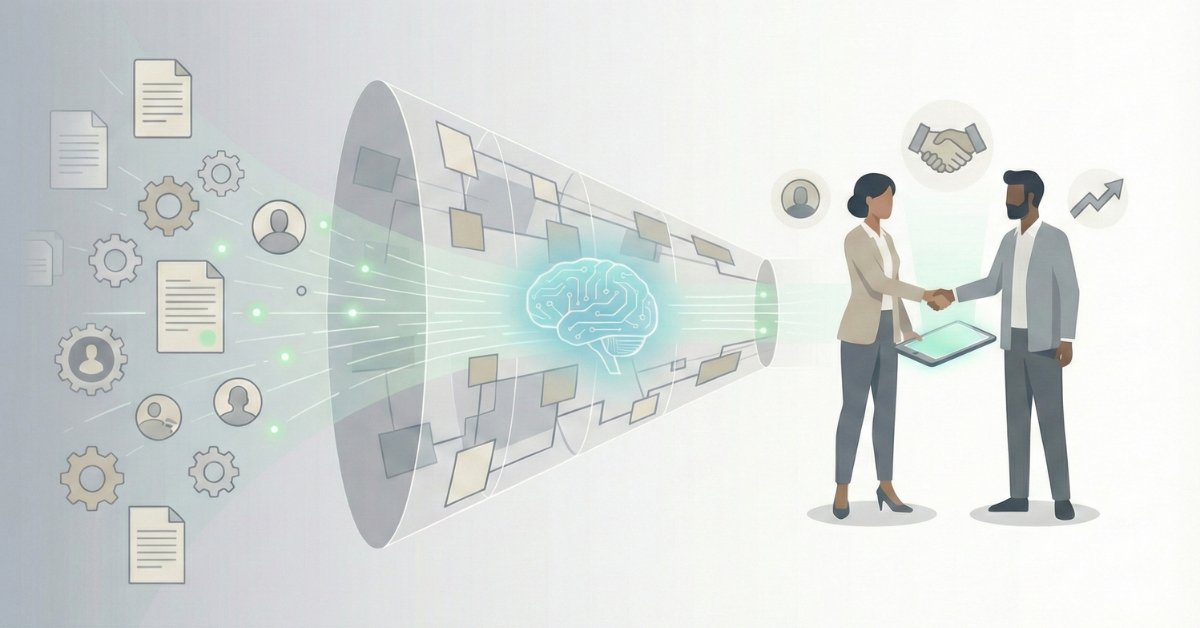
Service businesses don’t lose revenue because they lack leads. They lose revenue because their sales process can’t handle those leads consistently.
As inquiries increase, many service businesses rely on manual follow-ups, disconnected tools, and memory-driven sales workflows. Emails are sent late. Leads go cold. Sales conversations happen without context. And revenue becomes unpredictable not because the offer is weak, but because the system behind it is.
This is exactly why automated sales funnels for service businesses have become a critical growth lever. When implemented correctly, they create structure, consistency, and visibility across the entire sales journey from first touch to signed client.
However, most automated sales funnels fall short. Traditional automation relies on static rules and generic sequences that don’t adapt to real buyer behavior. For service businesses that sell through trust, timing, and conversations, this approach quickly breaks down.
The real shift happens when automation is combined with intelligence.
AI-powered automated sales funnels don’t just execute tasks. They analyze intent, personalize follow-ups, prioritize leads, and continuously improve decision-making across the funnel. Instead of forcing prospects through rigid workflows, they adapt to how people actually buy services.
This pillar guide explains how automated sales funnels work specifically for service businesses, where most implementations go wrong, and how AI transforms funnels into scalable, predictable growth systems without sacrificing the human element that service sales depend on.
Why Sales Processes Break as Service Businesses Grow
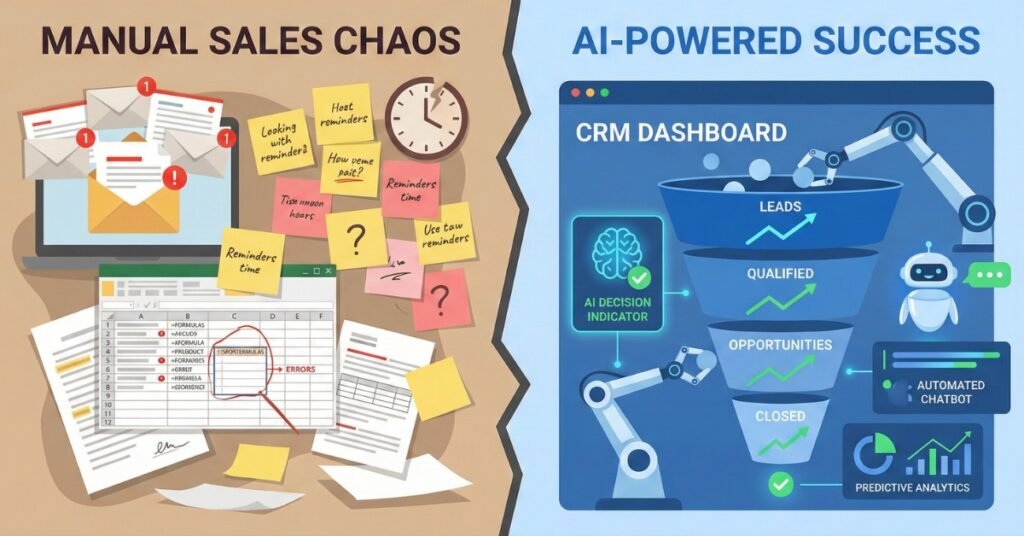
Early on, sales feel manageable because they’re personal. Founders remember who reached out, who needs a follow-up, and which leads feel promising. Intuition carries the process.
Growth changes everything.
As lead volume increases:
- Response times slow down
- Follow-ups become inconsistent
- Leads slip through the cracks
- Sales conversations lack context
- Pipeline visibility disappears
This isn’t a people problem. It’s a systems problem.
Hiring more sales reps or adding more tools without structure only increases complexity. What service businesses need at this stage is not more effort. It’s a repeatable, intelligent sales system.
That’s where automated sales funnels come in, but only if they’re built correctly.
What an Automated Sales Funnel Really Means for Service Businesses
An automated sales funnel for a service business is not a sequence of emails or a CRM pipeline template. It’s a relationship management system that supports high-consideration buying decisions.
A properly designed funnel ensures:
- Every lead is captured and tracked
- Every prospect receives timely, relevant communication
- Every sales conversation begins with context
- Every opportunity moves forward intentionally
Unlike ecommerce funnels, service funnels are not linear. Buyers pause, research, ask questions, and revisit decisions. The funnel’s role is to support momentum, not force speed.
Automation provides the structure. AI provides the intelligence that makes the structure effective.
The Hidden Limits of Traditional Sales Automation
Most sales automation today is rule-based.
If a form is submitted, send email A.
In case, there’s no reply, send reminder B.
If a call is booked, move the deal to stage C.
This approach improves efficiency, but only to a point.
Traditional automation:
- Treats all leads the same
- Can’t interpret intent
- Doesn’t adapt to engagement
- Requires constant manual tuning
- Breaks when buyer behavior changes
For service businesses, where context and timing are everything, this leads to automation that feels generic and disconnected from reality.
This is exactly where AI changes what a sales funnel can do.
How AI Transforms Automated Sales Funnels
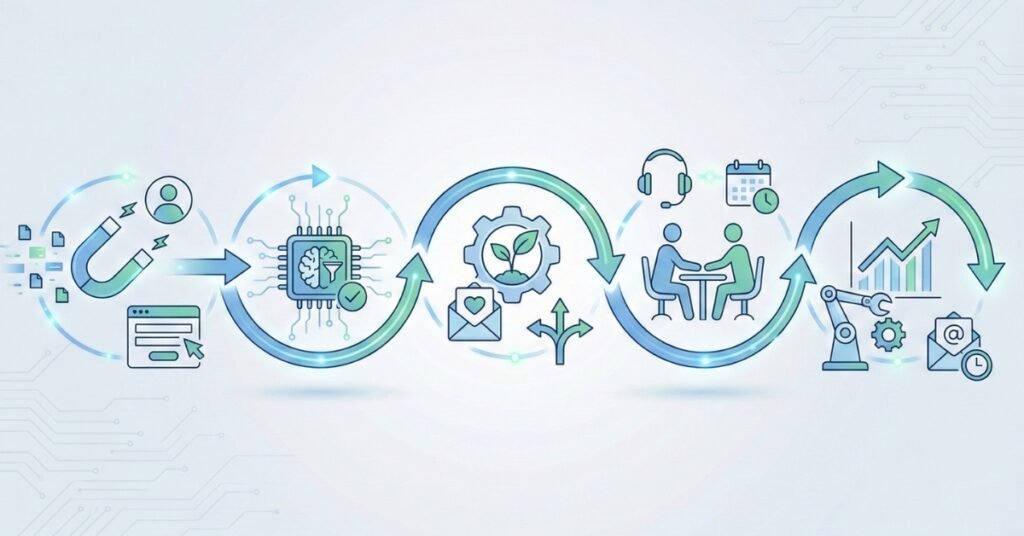
AI adds a decision layer to automation.
This is where AI-driven automation becomes more than a set of workflows and starts functioning as a system that can adapt, prioritize, and optimize across the entire customer journey. We’ve explored this approach in more depth in our breakdown of AI marketing automation.
Automation executes actions.
AI determines which actions matter, when they should happen, and why.
Instead of static workflows, AI-powered automated sales funnels respond to real behavior. This makes them especially powerful for service businesses, where buying decisions are rarely predictable.
Smarter Lead Qualification Without Manual Guesswork
Poor qualification is one of the most expensive problems in service sales. Every unqualified call drains time and momentum.
AI-powered funnels evaluate signals such as:
- How prospects interact with your website
- What content they engage with
- How quickly they respond
- The quality of their form answers
- Their acquisition source
Rather than relying on fixed scoring rules, AI identifies patterns that correlate with closed deals. High-intent leads are prioritized automatically. Lower-quality inquiries are handled professionally without consuming disproportionate sales resources.
The result isn’t fewer leads, it’s higher-quality conversations and stronger close rates.
Personalization That Scales Without Feeling Robotic
Service buyers expect relevance. Generic follow-ups erode trust.
AI enables personalization at scale by adapting communication based on actual behavior. Messaging changes based on engagement. Timing aligns with responsiveness. Content matches the buyer’s stage and concerns.
From the buyer’s perspective, nothing feels automated. From the business’s perspective, nothing relies on memory.
This balance is what makes AI-powered automated sales funnels effective rather than intrusive.
Seamless Handoffs Between Automation and Human Sales
Automation doesn’t replace human sales, it protects it.
By the time a prospect reaches a sales call, the funnel has already gathered context:
- What they care about
- What they’ve engaged with
- Where hesitation might exist
- How warm the opportunity really is
Sales conversations become focused, informed, and efficient. Follow-ups reference real context instead of generic templates.
Automation handles the mechanics. Humans handle trust and nuance.
Sales Funnel Stages for Service Businesses (With Examples)
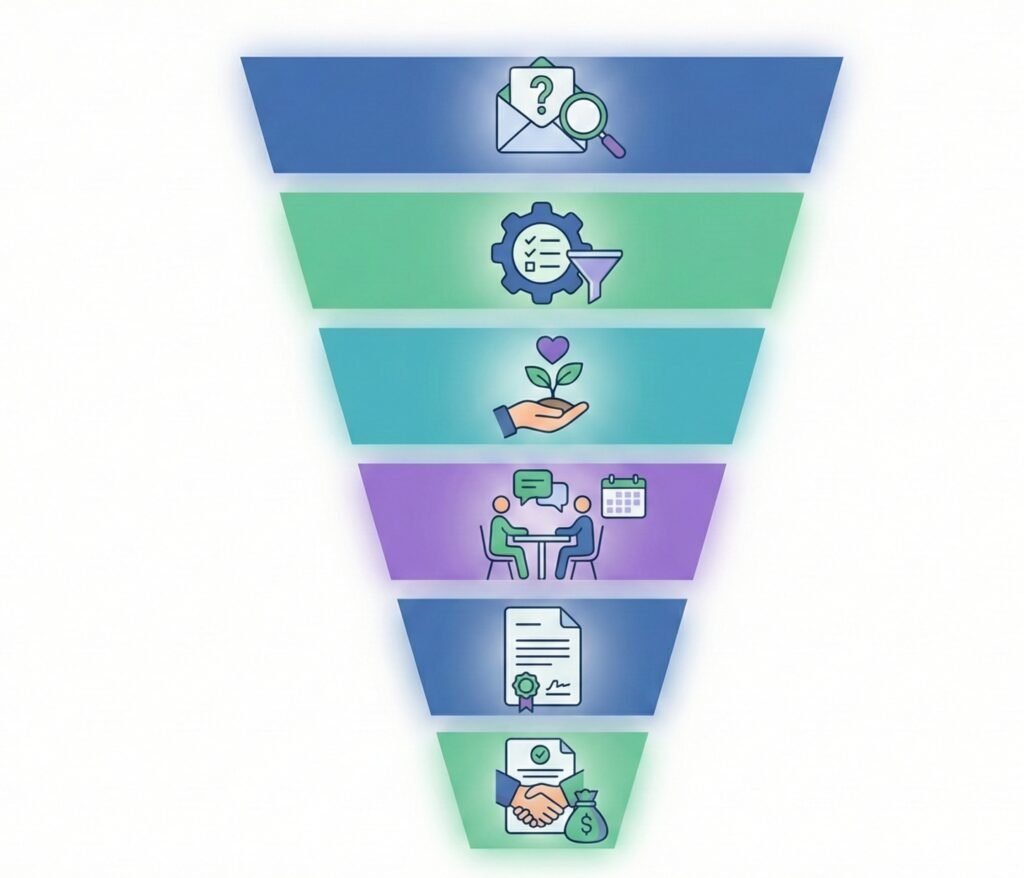
Unlike ecommerce, service funnels revolve around conversations. A typical service-business funnel includes:
Awareness and Inquiry
Prospects discover your business and submit an inquiry or opt in to content.
For many service businesses, the sales funnel actually begins long before an inquiry is submitted, often through AI-driven SEO and content strategies that shape intent and attract higher-quality leads from the start.
AI role:
Analyze intent signals and segment leads immediately.
Qualification
Not all inquiries are equal.
AI role:
Score and prioritize leads based on behavior, source, and responses.
Nurturing
Prospects who aren’t ready yet need education and reassurance.
AI role:
Deliver adaptive, personalized nurturing content based on engagement.
Consultation Booking
High-intent leads are invited to speak.
AI role:
Trigger booking invitations at the optimal moment.
Sales Conversation
The human connection happens here.
AI role:
Provide context and insights to sales before the call.
Proposal and Decision
Deals often stall at this stage.
AI role:
Guide follow-ups and re-engagement timing intelligently.
Close and Retention
The relationship doesn’t end at the sale.
AI role:
Support onboarding and long-term engagement.
Step-by-Step: How to Build an AI-Powered Automated Sales Funnel
This is where most guides stop short. Here’s a practical, service-business-focused approach.
Step 1: Define the Ideal Buyer Journey
Map how clients actually move from inquiry to decision.
Step 2: Centralize Lead Data
Your CRM must be the single source of truth.
Step 3: Automate Lead Capture and Routing
Ensure no inquiry goes untracked or unanswered.
Step 4: Introduce AI-Assisted Qualification
Use behavioral signals to prioritize leads automatically.
Step 5: Build Adaptive Nurturing Sequences
Create messaging that adjusts based on engagement.
Step 6: Automate Booking and Follow-Ups
Reduce friction around scheduling and post-call communication.
Step 7: Monitor, Learn, and Optimize
Let data guide improvements instead of assumptions.
Start simple. Expand intelligently.
Recommended Tool Stack for AI-Powered Sales Funnels
| Funnel Component | Purpose |
|---|---|
| CRM | Centralized pipeline and lead tracking |
| AI Qualification Layer | Lead scoring and prioritization |
| Automation Platform | Email, SMS, and workflow execution |
| Analytics | Funnel visibility and optimization |
The key is integration and logic, not the number of tools.
Where Automation Ends and Human Sales Begin
A common concern around automation is the fear of losing the human element. In practice, AI-powered funnels protect it.
By the time a prospect reaches a sales call, the system has already gathered context, what they’re interested in, what they’ve engaged with, and where potential objections may exist. Sales conversations become more focused, more relevant, and more valuable.
Automation handles the mechanics. Humans handle trust, nuance, and relationships.
This division of labor is what allows service businesses to scale without sacrificing quality.
A Realistic AI-Powered Sales Funnel in Practice
Consider a consulting firm offering high-ticket retainers.
A prospect submits an inquiry after engaging with educational content. The funnel captures the lead and evaluates intent based on behavior and responses. High-intent prospects are invited to book a call immediately. Others enter a short, personalized nurturing sequence.
As the prospect engages, the system adapts. When buying signals appear, the invitation to speak feels timely, not forced. After the call, follow-ups reflect what was discussed rather than relying on generic templates.
If the deal stalls, AI-driven logic determines when and how to re-engage, without pressure or guesswork.
Nothing is rushed. Nothing is forgotten.
Why Most Automated Sales Funnels Still Fail
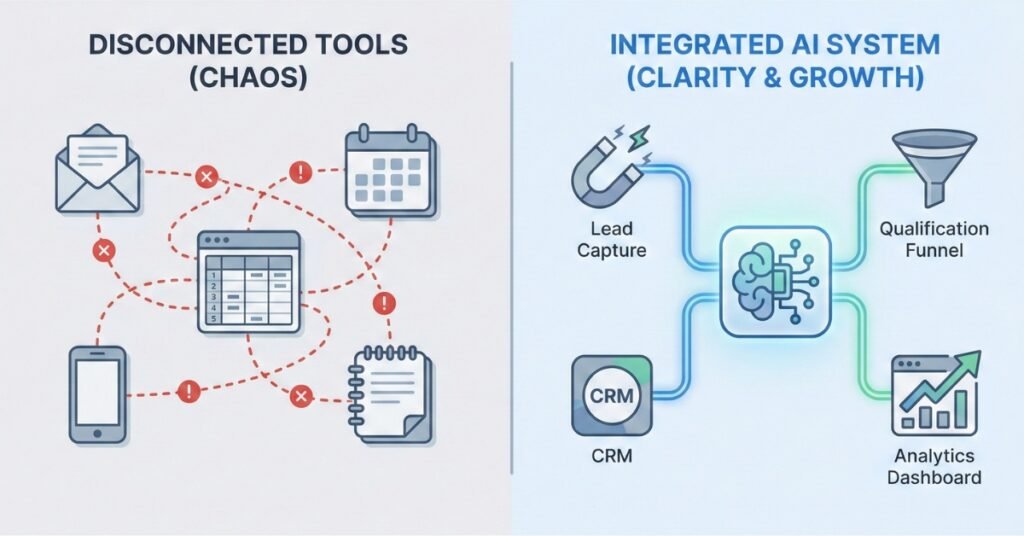
Despite better tools, many funnels underperform because they’re built without a clear strategy.
Businesses often start with software instead of systems. Tools are connected, but logic is missing. Automation exists, but it doesn’t reflect how buyers actually move.
A funnel is not a stack of apps. It’s an ecosystem.
Without a system-first approach:
- Data remains fragmented
- Automation conflicts with real behavior
- AI has nothing meaningful to optimize
- Teams lose confidence in the setup
Successful funnels are designed from the buyer’s journey outward, not from the tool inward.
Common Mistakes That Kill Automated Sales Funnels
Even well-intentioned funnels fail due to avoidable errors.
Common pitfalls include:
- Treating automation as “set and forget”
- Applying ecommerce funnel logic to service sales
- Over-automating early-stage conversations
- Ignoring behavioral signals
- Failing to close the feedback loop
AI only works when it’s part of a thoughtful system.
The Anatomy of an AI-Powered Sales Funnel System
At its core, every effective service funnel includes five elements working together.
A centralized CRM provides a single source of truth.
AI adds intelligence and prioritization.
Automation ensures consistent execution.
Human touchpoints anchor trust.
Performance insights guide continuous improvement.
When these components align, growth becomes predictable instead of reactive.
Who Benefits Most from AI-Powered Automated Sales Funnels
This approach delivers the greatest impact for service businesses that:
- Sell through conversations
- Handle inbound demand
- Offer high-value services
- Depend on trust and timing
- Want to scale without chaos
For agencies, consultants, and B2B service firms, even small efficiency gains compound quickly, making intelligent automation a competitive advantage, not a luxury.
How to Start Without Overengineering Your Funnel
The goal isn’t to automate everything overnight. It’s to automate what matters first.
Start by mapping your current sales journey. Identify where delays occur and where follow-ups rely on memory. Those friction points are your best automation opportunities.
Introduce AI where decisions matter most: qualification, prioritization, and timing. Let the system stabilize before expanding further.
Clarity always comes before complexity.
Frequently Asked Questions About Automated Sales Funnels for Service Businesses
A system that guides prospects through the sales journey using automation and intelligence to ensure consistent follow-up and better decision-making.
Yes. When designed around human-led sales, they improve consistency without removing the personal touch.
AI evaluates behavior and intent, allowing the funnel to adapt instead of following rigid rules.
No. It removes manual friction so sales teams can focus on meaningful conversations.
Improvements in response time and lead quality often appear quickly, with conversion gains compounding over time.
Why This Matters Now
Service buyers expect fast, relevant, and seamless experiences. Manual sales processes can’t keep up with those expectations indefinitely.
AI-powered automated sales funnels aren’t about chasing trends. They’re about building resilient systems that support growth instead of limiting it.
Automation executes.
AI thinks.
Systems scale service businesses.
The Next Step
If your sales process still depends on manual follow-ups, scattered tools, or intuition alone, the opportunity isn’t to work harder, it’s to build smarter.
An intelligently designed, AI-powered sales funnel gives you clarity, control, and consistency across your entire client acquisition process.
When you’re ready to replace manual sales chaos with an intelligent system built for growth, exploring a tailored sales automation strategy is the logical next step.