
SEO and content marketing are no longer driven by manual execution and intuition. They are being reshaped by artificial intelligence systems that analyze intent, predict outcomes, and automate optimization at a scale humans cannot match.
AI in SEO and content marketing is not about publishing more content faster. It is about building intelligent systems that replace manual chaos with structured, repeatable growth. Businesses that understand this shift are creating compounding advantages in visibility, authority, and lead generation. Those that do not are quietly falling behind.
This article explains how AI is transforming SEO and content marketing and how to move from fragmented tactics to a scalable system.
The Shift from Manual SEO to Intelligent Automation
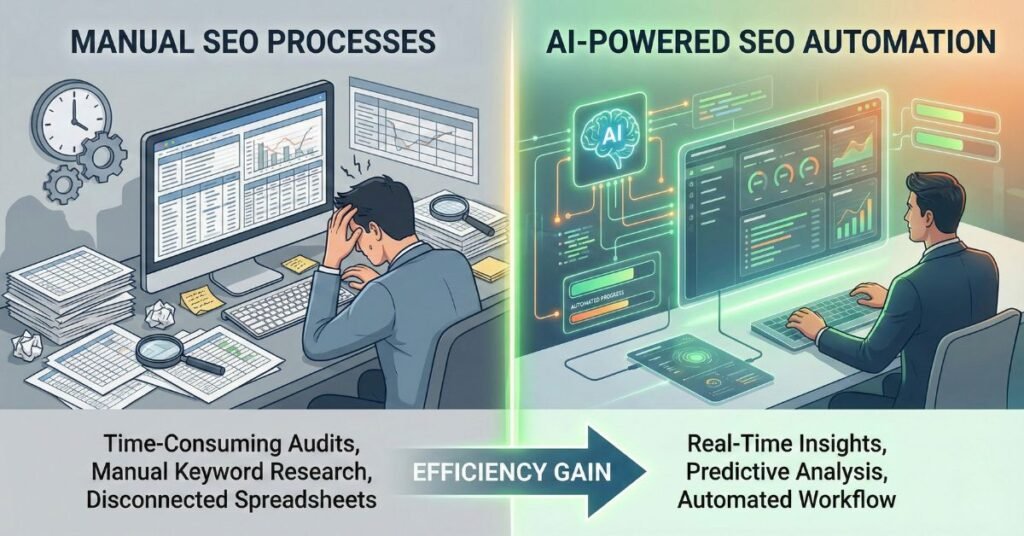
We have been defining SEO by manual processes such as keyword spreadsheets, backlink audits, and page-by-page optimization. Marketers relied on intuition and experience to guess what search engines valued. Google’s evolution from basic keyword matching to semantic and intent-based algorithms has changed this model entirely.
From Keywords to Context
The introduction of RankBrain and BERT marked the point where AI began shaping search behavior itself. Instead of focusing only on keywords, Google now interprets meaning. It evaluates how well content satisfies user intent.
SEO is no longer about what you say. It is about how relevant, useful, and complete your content feels to the searcher.
This is why AI-powered SEO outperforms manual optimization. Machine learning models evaluate context at a scale no human team can replicate consistently.
Automation as a Competitive Advantage
According to a 2025 HubSpot survey, more than 68 percent of marketers now use AI tools for SEO research, optimization, or analytics. Teams that automate repetitive tasks such as keyword clustering or metadata generation report up to 40 percent higher content velocity while maintaining or improving quality.
Automation is not only about efficiency. It is about decision quality. When AI systems process thousands of data points in seconds, human strategists regain time for strategy, creativity, and brand storytelling.
How AI Is Redefining Modern Content Marketing
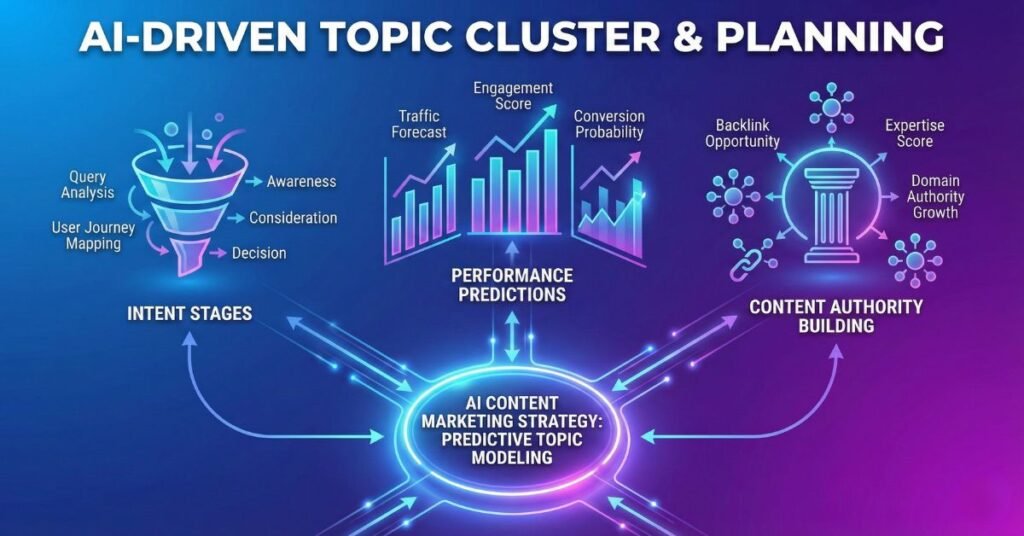
AI is transforming how content is planned, produced, and optimized at scale. It is not replacing marketers. It is giving them predictive intelligence that improves outcomes.
Predictive Topic Modeling
AI-driven content platforms analyze search queries, competitive content, and engagement signals to forecast which topics are likely to perform.
Instead of guessing what audiences want to read, teams can anticipate demand.
Platforms such as MarketMuse and Clearscope use machine learning to identify semantic gaps. These are topics where competitors rank, and your site does not. This allows marketers to build topical authority faster and more intentionally.
Hyper Personalization at Scale
With AI-powered analytics, content can be adapted dynamically based on audience behavior.
AI systems can:
- Adjust on-page recommendations
- Suggest dynamic calls to action
- Rewrite snippets to align with user intent
All of this happens without manual intervention, making personalization scalable rather than resource-intensive.
Performance Prediction
AI can estimate how content will perform before it is published. By analyzing structure, readability, tone, and keyword depth, predictive systems help teams prioritize content that is more likely to rank and convert.
This turns content marketing from a creative gamble into a strategic investment.
Inside the AI-Powered SEO Workflow
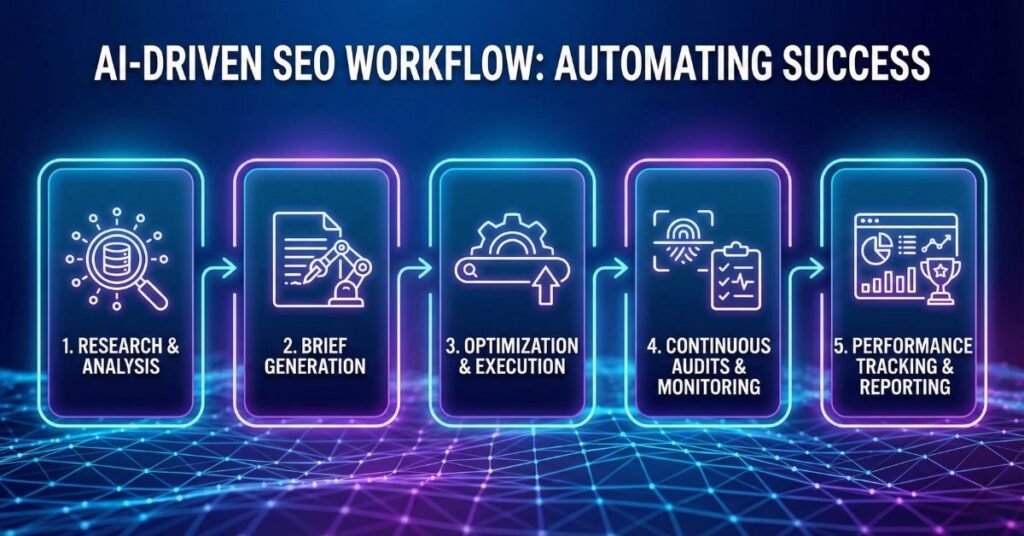
To understand how transformative AI truly is, it helps to compare modern workflows.
Keyword research shifts from manual lookups to automated clustering by search intent and relevance. Content briefs are no longer built from scratch. AI generates briefs with full semantic coverage. Optimization moves from keyword tracking to natural language processing that scores tone, readability, and topic alignment. Audits run continuously instead of periodically. Reporting moves from spreadsheets to automated dashboards with predictive insights.
The result is faster iteration, higher accuracy, and a content system that improves over time.
Building a Content Operations System That Scales with AI
AI delivers its greatest value when content operations are designed around it. The goal is not to stack tools. It is to build a unified system that integrates ideation, creation, optimization, and analytics.
SEO and content workflows rarely operate in isolation. When AI is applied across the broader marketing system, teams gain even more leverage through automation, orchestration, and data-driven decision making. This is where AI marketing automation becomes the connective layer that turns content into a scalable growth engine.
The AI Maturity Path for Marketers
Most teams progress through three stages.
The assistive stage uses AI for tasks like keyword suggestions, summarization, or tone refinement.
The integrated stage connects research, writing, optimization, and analytics into a single workflow.
The predictive stage uses AI to anticipate content performance and automate optimization cycles.
Teams that reach the predictive stage experience compounding gains in speed, efficiency, and engagement quality.
Case Example
A mid-sized SaaS company implemented AI-driven content briefs and automated audits. Content output increased by more than three times while maintaining editorial standards. The team redirected 40 percent of saved time toward strategy and experimentation, resulting in a measurable increase in conversions.
Common Pitfalls
The most common mistakes are strategic, not technical.
Publishing AI-generated text without human editing reduces trust. Ignoring originality and data governance creates risk. Treating AI as a collection of tools instead of a system leads to fragmentation.
AI must be integrated intentionally to deliver sustainable results.
The Human and AI Collaboration Advantage

AI excels at pattern recognition, speed, and predictive analysis. Humans excel at storytelling, judgment, and strategic interpretation.
The strongest workflows combine both.
AI surfaces insights. Humans shape the narrative. AI optimizes performance. Humans apply final review.
This loop ensures content remains authentic, authoritative, and competitive.
The Future of SEO and Content Marketing in an AI-First World

Search is evolving beyond static text. Conversational and multimodal experiences powered by large language models are changing how users discover information.
Key shifts already underway include:
- Conversational search reducing reliance on static pages
- Predictive SEO anticipating ranking factors before algorithm changes
- Autonomous content agents distributing micro content across channels
The takeaway is clear. SEO will reward systems thinking, not manual execution. Businesses that integrate AI early will benefit from speed, adaptability, and data precision.
How to Start Implementing AI in Your SEO and Content Strategy
You do not need a complex tech stack to begin.
Start by auditing your current workflow and identifying manual bottlenecks. Introduce AI for research, outlining, and analysis. Standardize prompts and brand inputs. Measure changes in velocity, engagement, and rankings. Expand into optimization and analytics once the foundation is stable.
Thinking in systems rather than tools is what future-proofs content operations.
Recommended Tool Categories
Research and ideation tools include Semrush, SurferSEO, and MarketMuse.
Optimization tools include Clearscope, Frase, and Writer.com.
Analytics and insight tools include Google Search Console, GrowthBar AI, and ChatGPT for analytics workflows.
FAQs: AI, SEO, and Content Marketing
No. AI automates execution. Human strategists guide creativity, positioning, and trust.
AI helps create more relevant and semantically rich content, which aligns with Google’s emphasis on user intent and experience.
Clearscope, SurferSEO, and Frase lead in natural language processing and content scoring.
No. Content quality and originality matter more than how it is produced.
Begin with one or two tools that automate research or optimization. Scale based on results.
Conclusion: The Next Era of Growth Is Intelligent
AI is not replacing marketers. It is redefining how effective marketing systems are built.
The brands that succeed will not be those that produce the most content. They will be the ones who build intelligent systems that learn, adapt, and scale.
If your marketing still depends on manual workflows, now is the time to modernize.
Ready to scale your SEO and content strategy with intelligent automation? Let’s build your AI-powered marketing system.